Friday, February 22, 2013
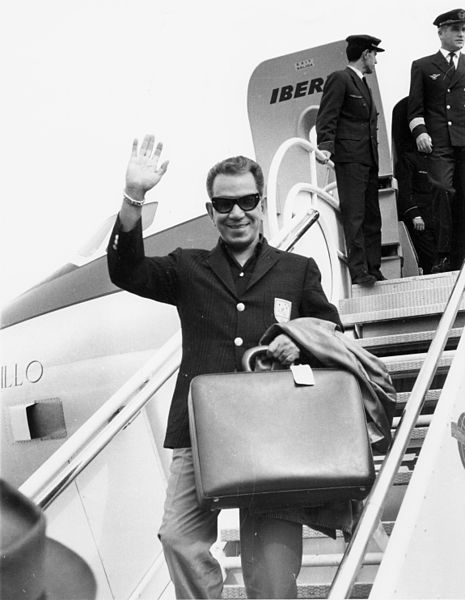
Cantinflas
Tuesday, August 21, 2012
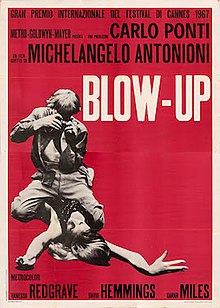
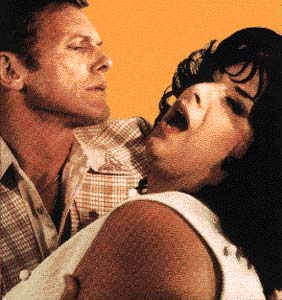
Blowup
The film also stars Vanessa Redgrave, Sarah Miles, John Castle, Jane Birkin, Tsai Chin and Gillian Hills as well as sixties model Veruschka. The screenplay was written by Antonioni and Tonino Guerra, with English dialogue by British playwright Edward Bond. The film was produced by Carlo Ponti, who had contracted Antonioni to make three English-language films for MGM (the others were Zabriskie Point and The Passenger).
The plot was inspired by Julio Cortázar's short story, "Las babas del diablo" or "The Devil's Drool" (1959), translated also as Blow-Up, and by the life of Swinging London photographer David Bailey. The film was scored by jazz pianist Herbie Hancock, although the music is diegetic, as Hancock noted: "It's only there when someone turns on the radio or puts on a record." Nominated for several awards at the Cannes Film Festival, Blowup won the Grand Prix.
The American release of the film with its explicit content (by contemporary standards) by a major Hollywood studio was in direct defiance of the Production Code. Its subsequent outstanding critical and box office success proved to be one of the final events that led the code to be finally abandoned in 1968 in favor of the MPAA film rating system.
Labels: Movies
Sunday, January 29, 2012
Pulgasari
Pulgasari is a North Korean feature film produced in 1985, a giant-monster film similar to the Japanese Godzilla series. It was produced by South Korean director Shin Sang-ok, who had been kidnapped in 1978 by North Korean intelligence on the orders of Kim Jong-il, son of the then-ruling Kim Il-sung. Teruyoshi Nakano and the staff from Japan's Toho studios, the creators of Godzilla, participated in creating the film's special effects. Kenpachiro Satsuma – the stunt performer who played Godzilla from 1984 to 1995 – portrayed Pulgasari, and when the Godzilla remake was released in Japan in 1998, he was quoted as saying he preferred Pulgasari to the American Godzilla.
The film is about a doll made of rice by a prisoner, which on coming into contact with blood, grows to become a giant metal-eating monster. Jonathan Ross stated that the film is intended to be a propaganda metaphor for the effects of unchecked capitalism and the power of the collective.
Labels: Movies
Thursday, October 13, 2011
Torchy Blane
Torchy Blane is a fictional female reporter who appeared in a series of light "B" films during the late 1930s, which were mixtures of mystery, action, adventure and fun. During the pre-war period, the job of newspaper reporter was one of the few movie role models that portrayed intelligent, career-oriented women. Of these role models, Torchy Blane was perhaps the best known. The typical plot has the resilient, very-fast-talking Torchy solving the crime before her less-than-perceptive beau, the loud mouthed police detective Steve McBride.
Torchy was loosely based on the male character Kennedy in the MacBride and Kennedy stories by Louis Frederick Nebel, although Torchy was more compatible with the Hays code than the drunkard Kennedy.
In all but two of the films, Torchy Blane was played by Glenda Farrell, and Steve McBride by Barton MacLane.
Lola Lane played Torchy in Torchy Blane in Panama with Paul Kelly as McBride. Torchy Blane was writer Jerry Siegel's inspiration for the character of Lois Lane in the Superman comic books. Siegel based her name on Torchy actress Lola Lane.
In the final film of the series, Torchy Plays with Dynamite, Jane Wyman was Torchy, and Allen Jenkins Lt. Steve McBride. Torchy Blane is a fast-talking newspaper reporter of the 1930s. She often becomes involved in police investigations, eventually leading to the capture of criminals. As her fiance, Steve Macbride, is usually involved in these investigations, he often comes under suspicion of favoritism.
Labels: Characters, Movies
Thursday, September 29, 2011
Bingo
Bingo is a 1998 computer-animated short film directed by Chris Landreth. The short is based on the stage play Disregard This Play by the theater troupe The Neo Futurists. It uses surrealistic imagery and dialogue to tell the story of an ordinary man who is surrounded by characters who insist that he is someone named "Bingo the Clown" even though he is not. Eventually, the man is worn down by their unwavering insistence and comes to believe that he is Bingo the Clown. At the time of Bingo's creation, Landreth was employed as an animator at Alias|Wavefront, and the film was used to demonstrate the capabilities of the company's new Maya animation software.
Bingo was shown at both technology trade shows, like the 1998 SIGGRAPH conference where it was shown as the grand finale of the Electronic Theater, and at more traditional film festivals. Some notable film festivals that showed Bingo during its initial release include the Sundance Film Festival, the Ottawa International Animation Festival, the Toronto Worldwide Short Film Festival, the Aspen Short Film Festival, and the Los Angeles Independent Film Festival.
The film received critical acclaim upon its release. Landreth did not submit Bingo to the Sundance Film Festival, but the festival organizers asked to show it anyway—a rare honor. At the Aspen Short Film Festival it won the "Animated Eye" award, it won the Audience Award for Best Short Film at the Los Angeles Independent Film Festival, and it won the Media Prize for Best Computer Animation at the Ottawa International Animation Festival.
In 1999, Bingo was given the Genie Award for Best Animated Short.
Friday, August 19, 2011
Master of the Flying Guillotine
Master of the Flying Guillotine is a 1975 Taiwanese / Hong Kong martial arts film starring Jimmy Wang Yu, who also wrote and directed the film. It is a sequel to Wang's 1971 film One Armed Boxer, and thus the film is also known as One-Armed Boxer 2 and The One Armed Boxer Vs. the Flying Guillotine.The film concerns Wang's one-armed martial arts master being stalked by an Imperial assassin, the master of two fighters (the Tibetan Lamas) who were killed in the previous film. When the One-Armed Boxer is invited to attend a martial arts tournament, his efforts to lay low are unsuccessful, and the assassin soon tracks him down with the help of his three subordinates competing in the tournament: a Thai boxer, a yoga master, and a kobojutsu user.
The title refers to the assassin's weapon, the "Flying guillotine" which resembles a hat with a bladed rim attached to a long chain. Upon enveloping one's head, the blades cleanly decapitate the victim with a quick pull of the chain.
Clips from the film's soundtrack (particularly the score whenever the assassin appears) have been sampled by Wu Tang Clan and has been mentioned in their lyrics. Quentin Tarantino has cited the film as "one of my favorite movies of all time."
Labels: Movies
Wednesday, July 13, 2011
Winnebago Man
Winnebago Man is a 2009 American documentary feature film directed by Ben Steinbauer that follows the Internet phenomenon created by a series of twenty-year-old outtakes from a Winnebago sales video featuring profane outbursts from the salesperson, Jack Rebney. Originally intended as an inside joke, the video spread across the globe first on VHS tape then via YouTube and other online video sites, earning the salesman the title of "The Angriest Man in the World". The documentary explores the story of the clip’s origin and how, two decades later, it affects the man who never even knew it existed. The film premiered at The South by Southwest Film Festival in Austin, Texas on March 14, 2009, and opened theatrically on July 9, 2010 at the Landmark Sunshine Cinema in New York, before expanding nationally.
A sixty minute version of Winnebago Man was aired in the UK on BBC Four on August 30, 2010 as part of the Storyville series of documentaries.
The documentary starts with Steinbauer's obsession with a widely circulated viral video featuring outtakes from an RV commercial shoot, centered around a cantankerous pitchman who regularly becomes outraged and flustered, cursing in colorful mannerisms. Steinbauer researches the video, and discovers that it had been circulating on VHS long before it appeared on the Internet.
Steinbauer ultimately tracks down the infamous "Winnebago Man": Jack Rebney. Steinbauer visits Rebney at his home in a remote mountain area in California. Steinbauer is surprised to find Rebney to be calm, congenial, and very articulate -- in contrast to his reputed ornery manner. Rebney at first claims ignorance about his own popularity on the Internet. Steinbauer returns home somewhat disappointed.
Later, Rebney begins contacting Steinbauer. He admits that he has always been aware of the video and its notoriety, and is petulant over it. Rebney expresses deep bitterness about the current (2005-2007) state of affairs in America. Steinbauer discovers that Rebney was once an accomplished news broadcaster, and that Rebney still wishes for his political opinions to be heard. Rebney invites Steinbauer for a second visit.
Shortly afterward, local papers report that Rebney has gone missing for some time. After he is safely returned home, Rebney reports the ordeal to Steinbauer. When Steinbauer makes his second visit to Rebney's home, Rebney explains that he is now blind.
Despite Rebney's cantankerous (albeit articulate) protests, Steinbauer takes him to the Found Footage Festival in San Francisco. There, fans have lined up for a sold-out screening of the original videos featuring Rebney. The fans describe Rebney's positive impact on them. During the screening, the Festival organizers invite Rebney on stage as a special guest, where he wittily engages the audience. After the screening, Rebney meets several fans who request autographs and express to him how viewing the old footage cheers them up after a hard day.
Later that night, Rebney muses to an old friend that, counter to his expectations, his fans are "clever, quick, observant people."
The next day, the filmmakers and Rebney's friend drive him back home. There, Rebney's friend tells him, "You made a lot of people happy this weekend." Rebney replies by acknowledging that he takes some small degree of pride in how, for many people, he represents the human condition in the face of adversity.
Wednesday, June 1, 2011
The Thing with Two Heads
The Thing with Two Heads is a 1972 film, starring Rosey Grier, Ray Milland and Don Marshall directed by Lee Frost, and written by Wes Bishop. Frost and Bishop also had parts in the movie. In the movie, Milland plays Dr. Maxwell Kirshner, a dying, wealthy racist who demands that his head be transplanted onto a healthy body. As his health rapidly deteriorates, there remains only one alternative: graft Kirshner's head onto the body of a black death row inmate, Jack Moss, played by Grier.
Monday, May 2, 2011
The Crimson Ghost
The Crimson Ghost (1946) is a Republic film serial directed by Fred C. Brannon and William Witney with Charles Quigley and Linda Stirling playing the leads. This was Witney's last serial, after a career that left him one of the most praised of all serial directors. In the 1990s The Crimson Ghost was one of only two Republic serials to be colorised. The villain of the serial, the Crimson Ghost of the title, is one of the most visually striking of the medium. The Misfits adapted his visage as their skull logo and he has appeared in an Iron Maiden video.In the early 1950s, The Crimson Ghost was one of fourteen Republic serials edited into a television series. It was broadcast in six 26½-minute episodes. The Crimson Ghost was one of twenty-six Republic serials re-released as a film on television in 1966. The title of the film was changed to Cyclotrode "X". This version was cut down to 100-minutes in length.
The poster for the Kansas City show, at the Max, on 28 March 1979 featured the first use of the Crimson Ghost by the band Misfits. The cover art for their Horror Business EP , the band's third single, would be the first time that the character would appear on a release by the band. It would continue to be used as the band's mascot and its skull image would serve as the Misfits' logo for the rest of their career.
Labels: Movies
Monday, April 25, 2011
Z Movie
The term Z movie (or grade-Z movie) arose in the mid-1960s as an informal description of certain unequivocally non-A films. It was soon adopted to characterize low-budget pictures with quality standards well below those of most B movies and even so-called C movies. While B movies may have mediocre scripts and actors who are relatively unknown or past their prime, they are for the most part competently lit, shot, and edited. The economizing shortcuts of films identified as C movies tend to be evident throughout; nonetheless, films to which the C label is applied are generally the products of relatively stable entities within the commercial film industry and thus still adhere to certain production norms. In contrast, most films referred to as Z movies are made for very little money on the fringes of the organized film industry or entirely outside it. As a result, scripts are often laughably bad, continuity errors tend to arise during shooting, and nonprofessional actors are frequently cast. Many Z movies are also poorly lit and edited. Latter-day Zs may not evidence the same degree of technical incompetence; in addition to bargain-basement scripts and acting, they are often characterized by violent, gory, and/or sexual content and a minimum of artistic interest, readily falling into the category of exploitation, or "grindhouse" films.
Director Ed Wood is often described as the quintessential maker of Z movies, yet his work reveals the ambiguity of the category. Certain very-low-budget pictures of his such as Glen or Glenda (1953) and Jail Bait (1954), though broadly and risibly incompetent, are also entertaining on their own terms and evidence an intriguing artistic vision.[2] Wood's Plan 9 from Outer Space (1959) is often labeled the worst film ever made. It features an incoherent plot, bizarre dialogue, inept acting, intrusive narration, the cheapest conceivable special effects, and cardboard sets that the actors occasionally bump into and knock over. Stock footage is used throughout, whole sequences are used multiple times, boom mics are visible, and actors frequently appear to be reading from cue cards. Outdoor sequences contain parts filmed during both day and night in the same scene. The movie stars Maila Nurmi, in her Vampira persona, and Béla Lugosi, who died before it was made. Test footage of Lugosi shot for a different project is intercut with shots of a double with a different physique, height, and hair color, who covers his face with a cape in every scene. The narrator refers to the film by its preproduction name, "Grave Robbers from Outer Space."[3]
The Creeping Terror (1964), directed by Arthur J. Nelson (who also stars in the film under the pseudonym Vic Savage), uses some memorable bargain-basement effects: Stock footage of a rocket launch is played in reverse to depict the landing of an alien spacecraft. What appears to be shag carpet is draped over several actors shambling about at a snail's pace, thus bringing the monstrous "creeping terror" to the screen. The movie also employs a technique that has come to be synonymous with Z-movie horror: voiceover narration that paraphrases dialogue being silently enacted onscreen.
Harold P. Warren, a fertilizer salesman who never worked in film before or since, directed Manos: The Hands of Fate (1966). The film is famous for its incompetent production, which included the use of a camera that could not record sound, disjointed dialogue, and seemingly random editing. The entire soundtrack was recorded by just three people, who provide the voices for every character. The movie features a character named Torgo, who is intended to be a satyr. The actor wore his prosthetics incorrectly, making it look like he simply has very large knees. In one scene, the clapboard is clearly visible. Like Plan 9, it frequently tops lists of the worst movies ever made.
The latter-day Z movie is typified by such pictures as Attack of the 60 Foot Centerfold (1995) and Bikini Cavegirl (2004), both directed by Fred Olen Ray, that combine traditional genre themes with extensive nudity or softcore pornography. Such pictures, often after going straight to video, are fodder for late-night airing on subscription TV services.
Labels: Movies
Tuesday, March 15, 2011
Urgh! A Music War
Urgh! A Music War is a British film released in 1982 featuring performances by punk rock, New Wave, and post-punk acts, filmed in 1980. Among the artists featured in the movie are Magazine, The Go-Go's, The Fleshtones, Joan Jett and the Blackhearts, XTC, Devo, The Cramps, Oingo Boingo, Dead Kennedys, Gary Numan, Klaus Nomi, Wall of Voodoo, Pere Ubu, Steel Pulse, Surf Punks, 999, UB40, Echo & the Bunnymen and The Police. These were many of the most popular groups on the New Wave scene; in keeping with the spirit of the scene, the film also features several less famous acts, and one completely obscure group, Invisible Sex, in what appears to be their single public outing.Urgh! A Music War consists of a series of performances, without narration or explanatory text. All performances are live, recorded around 1980, mainly in England and the USA. Clips were also taken from a concert in Fréjus, Var, France with The Police, XTC, Skafish and UB40 among others.
To coincide with the film, A&M Records released a double-album soundtrack. The selection of songs was almost the same as the film, but there were a few minor changes and several acts featured in the film did not make it to the album (John Cooper Clarke, Chelsea, Surf Punks, Invisible Sex, Splodgenessabounds).
Urgh! A Music War was briefly released to theatres by Filmways Pictures, but acquired a cult following in the United States in the 1980s due to its frequent showings on USA Network. It aired on VH1 Classic on October 30, 2006 as part of its Rock and Roll Picture series. The film has been released on videocassette, LaserDisc, and as of the present time, on DVD.
The film rights are owned by both its original producer, Miles Copeland (founder of IRS Records), and Warner Bros. Pictures (successor-in-interest to production company Lorimar). However the rights to distribute the film on electronic media have been, until recently, mired in red tape. A popular theory was that the rights were "lost" as a result of the collapse of the failed CED or SelectaVision videodisc format — to promote the adoption of the format, RCA reportedly purchased exclusive rights to Urgh! such that it could not appear on any other media without re-negotiation. When Thomson Electronics acquired RCA, SelectaVision was a dead issue for them.
The more likely scenario is that much like other films from the 1970s and 1980s, the original contracts covering the artists and songs in the film only covered existing media, and that all those details would have to be renegotiated for any new media such as CDs, DVDs, or mp3 downloading. Naturally, with the large number of labels and publishers controlling the material, combined with the increased value of the music, to reclear the performances would be extremely cost-prohibitive and time-consuming. It is rumored that three songs from each band were filmed and saved during the editing process and that Copeland has these in storage. There is the potential for a six-hour special edition, possibly containing over 100 songs, should Copeland and Warner Bros. decide to release it later.
Exhibition rights were retained by Copeland, and Urgh! has been shown on TV numerous times, including recent airings on VH1 and various cable-only channels. As the film prints aged and songs became damaged, airings were often edited to remove damaged songs. In some cases, additional material not filmed for the movie was added to fill space. In particular, Night Flight aired a heavily augmented version of the movie spread out over an entire night on several occasions. This included additional material by Wall of Voodoo, The Cramps and Alleycats that were not filmed for the movie, as well as other bands that were popular at the time. Notably missing from almost all recent broadcasts is the Gary Numan song "Down in the Park." Because Numan once again owns the rights to this footage, it is speculated that he has refused the broadcast rights to the clip.
Other portions of Urgh! appear elsewhere in film and video: The Klaus Nomi clip "Total Eclipse" appears in the 2004 documentary The Nomi Song, and details of its filming are discussed. The 1982 documentary The Police: Around The World was also filmed by Derek Burbidge and features footage used in Urgh! as well as other footage filmed at the same concert.
In addition to recent cable showings, some of the remaining intact prints of the movie have toured the USA in recent years (one tour sponsored by the humor periodical The Onion), and video showings in clubs and film houses have sparked a resurgence of interest in the film, which resulted in a DVD release by Warner Bros. as part of its "Warner Archive" series of DVD issues of their lesser-known titles from the WB vaults. It is now available via the WB web site.
Tuesday, February 15, 2011
Baby Burlesks
Baby Burlesks is the collective series title of eight thematically unrelated one-reeler films produced by Jack Hays and directed by Charles Lamont for Educational Pictures in 1932 and 1933. The eight films are satires on major motion pictures, film stars, celebrities, and current events, and are sometimes racist and sexist. Cast members are preschoolers clad in adult costumes on the top and diapers fastened with large safety pins on the bottom. Many of the children employed in the series were recruited from Meglin's Dance School in Hollywood, and, when not rehearsing or shooting, were sent out by the studio as advertising models for a variety of products (including breakfast cereals and cigars) in order to underwrite the costs of film production.
The series is notable for featuring three-year old Shirley Temple in her first screen appearances, and, in her 1988 autobiography, the actress describes the Baby Burlesks as "a cynical exploitation of our childish innocence." She also said the films were "the best things I ever did."
Labels: Movies
Friday, January 21, 2011
Drive-in Theater
A drive-in theater is a form of cinema structure consisting of a large outdoor screen, a projection booth, a concession stand and a large parking area for automobiles. Within this enclosed area, customers can view movies from the privacy and comfort of their cars. The screen can be as simple as a wall that is painted white, or it can be a complex steel truss structure with a complex finish. Originally, a movie's sound was provided by speakers on the screen and later by an individual speaker hung from the window of each car, which would be attached by a wire. This system was superseded by the more economical and less damage-prone method of broadcasting the soundtrack at a low output power on AM or FM Radio to be picked up by a car radio.
The drive-in theater was the creation of Camden, New Jersey, chemical company magnate Richard M. Hollingshead, Jr., whose family owned and operated the R.M. Hollingshead Corporation chemical plant in Camden. Hollingshead's drive-in opened in New Jersey June 6, 1933, on Admiral Wilson Boulevard at the Airport Circle in Pennsauken, a short distance from Cooper River Park. It offered 500 slots and a 40 by 50 ft screen. He advertised his drive-in theater with the slogan, "The whole family is welcome, regardless of how noisy the children are." The facility only operated three years, but during that time the concept caught on in other states.
The drive-in's peak popularity came in the late 1950s and early 1960s, particularly in rural areas, with some 4,000 drive-ins spreading across the United States. Among its advantages was the fact that a family with a baby could take care of their child while watching a movie, while teenagers with access to autos found drive-ins ideal for dates.
In the 1950s, the greater privacy afforded to patrons gave drive-ins a reputation as immoral, and they were labeled "passion pits" in the media. During the 1970s, some drive-ins changed from family fare to exploitation films, as a way to offset declining patronage and revenue. In fact some producers in the 1970s would make exploitation films directly for the drive-in market. Also, during the 1970s, some drive-ins began to show pornographic movies in less family-centered time slots to bring in extra income. This became a problem because it allowed for censored materials to be available to a wide audience, some for whom viewing was illegal, and it was reliant upon the whims of local ordinances controlling such material.
Over time, the economics of real estate made the large property areas increasingly expensive for drive-ins to operate successfully. Land became far too valuable for businesses like drive-ins, which in most cases were summer-only. Widespread adoption of daylight saving time subtracted an hour from outdoor evening viewing time. These changes and the advent of color televisions, VCRs and video rentals led to a sharp decline in the drive-in popularity. Drive-ins were subject to the whim of nature as inclement weather often caused cancellations. They eventually lapsed into a quasi-novelty status with the remaining handful catering to a generally nostalgic audience, though many drive-ins continue to successfully operate in some areas.
Many drive-in movie sites remain, repurposed as storage or flea markets sites, often after residential housing or other higher value uses came to the lightly-populated or unpopulated areas where the drive-ins were located.Sunday, October 31, 2010
Sleepaway Camp
Sleepaway Camp is a 1983 cult classic horror movie written and directed by Robert Hiltzik—who also served as executive producer. The film is about teen campers getting killed at a summer camp. The film came at a time when slasher films were in their heyday. It was a somewhat surprise hit. The film is widely known for having one of the most shocking endings in cinematic history.On its opening weekend it had grossed a total of $430,000 in the US. When it opened, it was the top grossing film in New York, beating out its horror competition by taking in almost double the gross of Amityville 3-D. Sleepaway Camp attained a modest success in its theatrical run.
Over the years, the Sleepaway Camp films gained a loyal cult following. In the late 1980s, Michael A. Simpson directed two sequels, Sleepaway Camp II: Unhappy Campers (1988) and Sleepaway Camp III: Teenage Wasteland (1989).
Another rogue sequel, Sleepaway Camp IV: The Survivor, directed by Jim Markovic, was partially filmed but never completed. In 2002 the unfinished footage was released and made available as an exclusive fourth disc in Anchor Bay/Starz Entertainment's Sleepaway Camp DVD boxed set.
A new film, Return to Sleepaway Camp, was completed in 2003 and initially struggled to find distribution. It was directed by Robert Hiltzik, the director of the original 1983 film. He decided that this chapter will ignore the story lines of the previous sequels, stating that he wanted to pick up from where the original film ended. According to Fangoria.com the digital effects were redone from 2006 to 2008. The film finally found distribution, and was released November 4, 2008, by Magnolia/Magnet Pictures. Review copies of the film had been sent out, and the movie's screener had already been leaked prior to the release.
The purportedly final film in Hiltzik's SC trilogy is also in the making. Its working title is Sleepaway Camp Reunion, distribution has already been arranged via Magnolia Pictures, for DVD with a limited theatrical release planned in 3D.
Labels: Movies
Monday, October 11, 2010
True Stories
The film features Byrne as an unnamed, cowboy-hat-wearing stranger who visits the fictional Texas town of Virgil, where he observes the citizens as they prepare for the Celebration of Special-ness, sponsored by the Varicorp Corporation. Byrne breaks the fourth wall many times in the movie while he is narrating in his car.
Among the unique individuals the stranger meets is Louis Fyne, played by John Goodman (in one of his first major film roles) - a Country-Western-singing clean room technician at a local computer manufacturing plant who is unlucky in love. He also encounters: town leader Earl Culver (played by performance artist Spalding Gray), who never speaks directly to his wife; Miss Rollings (Swoosie Kurtz), who never leaves her bed; Mr. Tucker (Pops Staples of The Staple Singers), a voodoo practitioner whom Louis hires to help him find love; a conspiracy theorist preacher (John Ingle) whose shtick owes a great deal to the Church of the SubGenius (in real life, Byrne is a SubGenius himself); Ramon (played by musician Tito Larriva), who claims telepathic powers; and a character billed only as "The Lying Woman" (Jo Harvey Allen), who recounts fantastic episodes from her history to anyone present. Renowned Latin music legend Esteban "Steve" Jordan and his conjunto perform the song, Radio Head in the film as well.
The movie was not a commercial success at the time of its release, and it received a mixed reaction from critics (though some, such as Roger Ebert, delivered glowing reviews). The film has achieved its greatest success in home video release, as a cult classic among fans of Byrne's work.
Labels: Movies
Saturday, August 7, 2010
35 mm film
35 mm film is the basic film gauge most commonly used for chemical still photography (see 135 film) and motion pictures, and remains relatively unchanged since its introduction in 1892 by William Dickson and Thomas Edison, using film stock supplied by George Eastman. The photographic film is cut into strips 35 millimeters (about 1 3/8 inches) wide — hence the name. The standard negative pulldown for movies ("single-frame" format) is four perforations per frame along both edges, which makes for exactly 16 frames per foot (for stills, the standard frame is eight perforations). A wide variety of largely proprietary gauges were used by the numerous camera and projection systems invented independently in the late 19th century and early 20th century, ranging from 13 mm to 75 mm (0.51–2.95 in). 35 mm was eventually recognized as the international standard gauge in 1909, and has remained by far the dominant film gauge for image origination and projection despite challenges from smaller and larger gauges, and from novel formats, because its size allows for a relatively good tradeoff between the cost of the film stock and the quality of the images captured. The ubiquity of 35 mm movie projectors in commercial movie theaters makes it the only motion picture format, film or video, that can be played in almost any cinema in the world.
The gauge is remarkably versatile in application. In the past one hundred years, it has been modified to include sound, redesigned to create a safer film base, formulated to capture color, has accommodated a bevy of widescreen formats, and has incorporated digital sound data into nearly all of its non-frame areas. Since the beginning of the 21st century, Eastman Kodak and Fujifilm have held a duopoly in the manufacture of 35 mm motion picture film.
Labels: Movies
Friday, July 16, 2010
Scopitone
A Scopitone is a type of jukebox featuring a 16 mm film component. It was a forerunner of music video. The Italian Cinebox/Colorama and Color-Sonics were competing, lesser-known technologies of the time. Based on technology developed during World War II, color 16 mm film clips with a magnetic soundtrack were designed to be shown in a specially designed jukebox. The first Scopitones were made in France, among them Serge Gainsbourg's Le poinçonneur des Lilas (filmed in 1958 in the Porte des Lilas Métro station), Johnny Hallyday's "Noir c'est noir" (a cover of Los Bravos' "Black Is Black") and the "Hully Gully" showing a dance around the edge of a French swimming pool.
Scopitones spread to West Germany, where the Kessler Sisters burst out of twin steamer trunks to sing "Quando Quando" on the screen that surmounted the jukebox. Scopitone went on to appear in bars in England, including a coffee bar in Swanage where Telstar was a favourite. By 1964, approximately 500 machines were installed in the USA, according to Time magazine.
Several well-known acts of the 1960s appear in Scopitone films, ranging from the earlier part of the decade The Exciters ("Tell Him") and Neil Sedaka ("Calendar Girl") to Procol Harum's ("A Whiter Shade of Pale") later on. In one Scopitone recording, Dionne Warwick lay on a white shag rug with an offstage fan urging her to sing "Walk On By". Another had Nancy Sinatra and a troupe of go-go girls shimmy to "These Boots Are Made for Walkin'". Inspired by burlesque, blonde bombshell Joi Lansing performed "Web of Love" and "The Silencer", and Julie London sang "Daddy" against a backdrop of strippers. The artifice of such scenes led Susan Sontag to identify Scopitone films as "part of the canon of Camp" in her 1964 essay "Notes on 'Camp'."
By the end of the 1960s, the popularity of the Scopitone had faded. The last film for a Scopitone was made at the end of 1978. However, in 2006 the French singer Mareva Galanter released several videos which mimic the Scopitone style. Galenta's album Ukuyéyé features several songs in the French Yé-yé style. She also recently hosted a weekly French television program called "Do you do you Scopitone" on the Paris Première channel.
As of the mid-2000s, one of the few Scopitones not in a museum or private collection in the United States was located at the Belcourt Theatre in Nashville, Tennessee.
Wednesday, July 7, 2010
Human Highway
Human Highway is a 1982 comedy film starring and co-directed by Neil Young under his pseudonym Bernard Shakey. Dean Stockwell co-directed the film and acted along with Russ Tamblyn, Dennis Hopper, and the post-punk and new wave band Devo. Included is an unusual collaborative performance of "Hey Hey, My My (Into the Black)" by Devo and Neil Young with Booji Boy singing lead vocals and Young playing lead guitar. The film was shown in only select theaters and was not released on VHS until 1995. It received poor reviews upon its premiere and with the benefit of hindsight has received favorable reviews more recently.
Much of the filming was in 1978 on a Hollywood soundstage. Over four years Young spent $3,000,000 of his own money on production. A portion of the dream sequence was filmed at Taos Pueblo, New Mexico. The soundstage set which included the diner and gas station was built to Young's specific requests. Young's initial idea was to portray a day in the life of Lionel and his bystanders during the Earth's last day. The actors were to develop their own characters. The script was a combination of improvisation and developing small story lines as they went. Young, Stockwell and Tamblyn were central in the writing.
Dennis Hopper who played the addled cook was performing knife tricks with real knives on the set. Actress Sally Kirkland attempted to take a knife from him and severed a tendon. She spent time in a hospital and later sued claiming Hopper was out of control. Hopper has admitted to drug abuse during this time period.
For Devo it was their first experience with Hollywood. Gerald Casale said the band felt removed observing the odd behaviors including excessive alcohol and drug abuse and rock star adulation with Young as the central "most grounded" person.
The "Hey Hey My My" footage with Devo was recorded at Different Fur, San Francisco. Mark Mothersbaugh as "Booji Boy" during this performance inserted the Devo line, "rust never sleeps". The line would soon after become the inspiration for Young's works with the same name.Labels: Movies
Saturday, June 19, 2010
Gumnaam
Gumnaam (Urdu for "unknown" or "anonymous") is a 1965 Hindi ghost movie directed by Raja Nawathe, starring Manoj Kumar, Nanda, Pran, Helen and Mehmood. The film became a box office hit. The story is based on Agatha Christie's novel "And Then There Were None".
The film came to wider attention when its opening song Jaan Pehechan Ho (a Hindi phrase roughly translated as "We should get to know each other") was in the opening credits of Ghost World. It is sung by Bollywood legend Mohammed Rafi, although he is not the man pictured; the main dancer is Laxmi Chhaya.
Seven people mysteriously win a free vacation. On the way to their destination, the plane has engine trouble and they are left abandoned in a remote seaside location. They find shelter in a large mansion inhabited by a comical butler Mehmood. One by one, they are murdered and the remaining vacationers try to figure out why they were chosen for the trip and what they have in common.
Labels: Movies
Saturday, April 10, 2010
Polyester
Polyester is a 1981 American John Waters comedy film starring Divine, Tab Hunter, Edith Massey, and Mink Stole. It was filmed in Waters' native Baltimore, Maryland, and features a gimmick called "Odorama", whereby viewers could smell what they saw on screen through scratch and sniff cards. The film is a satire of suburban life involving divorce, abortion, adultery, alcoholism, foot fetishism, and the Religious Right.
Polyester was meant as a send-up of “women’s pictures,” an exploitative genre of film that was popular from the 1950s-60s and typically featured bored, unfulfilled, or otherwise troubled women, usually middle-aged suburban housewives, finding release or escape through the arrival of a handsome younger man. “Women’s pictures” were typically hackneyed B-movies, but Waters specifically styled Polyester after the work of the director Douglas Sirk, making use of similar lighting and editing techniques, even using film equipment and movie-making techniques from Sirk's era.
Labels: Movies