Showing posts with label People. Show all posts

Friday, February 22, 2013

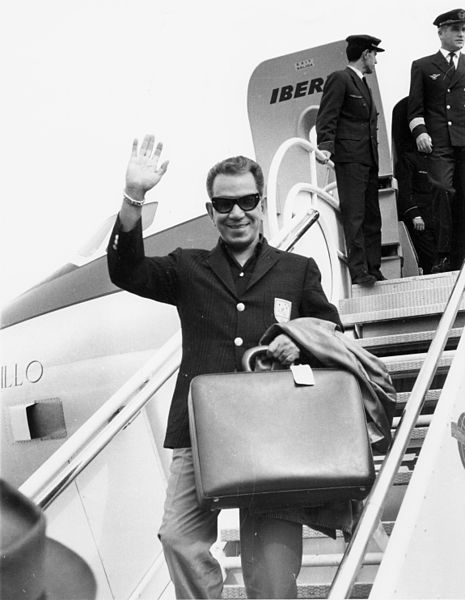
Cantinflas


Fortino Mario Alfonso Moreno Reyes, although he called himself Mario Moreno, (August 12, 1911 – April 20, 1993), was a Mexican comic film actor, producer, and screenwriter known professionally as Cantinflas. He often portrayed impoverished campesinos or a peasant of pelado origin. The character came to be associated with the national identity of Mexico, and allowed Cantinflas to establish a long, successful film career that included a foray into HollywoodCharlie Chaplin once commented that he was the best comedian alive, and Moreno has been referred to as the "Charlie Chaplin of Mexico". To audiences in the United States, he is best remembered as co-starring with David Niven in a Golden Globe Award-winning role in the 1956 film Around the World in 80 Days.
As a pioneer of the cinema of Mexico, Moreno helped usher in its golden era. In addition to being a business leader, he also became involved in Mexico's tangled and often dangerous labor politics. Although he was a political conservative, his reputation as a spokesperson for the downtrodden gave his actions authenticity and became important in the early struggle against charrismo, the one-partygovernment's practice of co-opting and controlling unions.
Moreover, his character Cantinflas, whose identity became enmeshed with his own, was examined by media critics, philosophers, and linguists, who saw him variably as a danger to Mexican society, a bourgeois puppet, a kind philanthropist, a transgressor of gender roles, a pious Catholic, a verbal innovator, and a picaresque underdog.

Sunday, May 13, 2012

Cutman

A cutman is a person responsible for preventing and treating physical damage to a fighter during the breaks between rounds of a full contact match such as a boxing, kickboxing or a mixed martial arts bout. Cutmen typically handle swelling, nosebleeds and lacerations (commonly called cuts). The rules of full contact sports stipulate that these injuries can be a cause for premature match stoppage, counting as a loss to the injured fighter. The cutman is therefore essential to the fighter, and can be a decisive factor in the outcome of the match.
The compensation for cutmen varies, generally staying within 1-3% of fighter's prize money. For many fighters on a low budget, the cutman duties are performed by their cornerman. While most athletic commissions require cutmen to be licensed, there is usually no formal training or certification required. Most cutmen learn their trade through apprenticeship and self-education.
Unlike boxing, cutmen for mixed martial arts events are generally provided by the promotion, rather than the fighter's corner. This is to prevent allegations of "greasing" (applying petroleum jelly to areas other than the forehead, which provides an unfair advantage in grappling situations).
Cutmen should not be confused with the fight doctor who is an official that monitors the health of the fighters, and whose task is closer to that of neutral referees, providing medical advice and monitoring the safety of both fighters in accordance with regulations or law and evaluates their ability to continue fighting.

Monday, May 7, 2012

Robert Bunsen

Robert Wilhelm Eberhard Bunsen (30 March 1811 – 16 August 1899) was a German chemist. He investigated emission spectra of heated elements, and discovered caesium (in 1860) and rubidium (in 1861) with Gustav Kirchhoff. Bunsen developed several gas-analytical methods, was a pioneer in photochemistry, and did early work in the field of organoarsenic chemistry. With his laboratory assistant, Peter Desaga, he developed the Bunsen burner, an improvement on the laboratory burners then in use. The Bunsen–Kirchhoff Award for spectroscopy is named after Bunsen and Kirchhoff.

Monday, March 12, 2012

Barbarian

Barbarian is a pejorative terms used to refer to a person who is perceived to be uncivilized. The word is often used either in a general reference to a member of a nation or ethnos, typically a tribal society as seen by an urban civilization either viewed as inferior, or admired as a noble savage. In idiomatic or figurative usage, a "barbarian" may also be an individual reference to a brutal, cruel, warlike, insensitive person.
The term originates in the ancient Greek civilization, meaning "anyone who is not Greek", and thus was often used to refer to other civilized people, such as the people of the Persian Empire. Comparable notions are found in non-European civilizations.

The primary function of the word "barbarian", and its cognates, is to differentiate members of one's own society from people perceived as being outside of it, and to posit that one's own culture is superior. The word barbaros in Ancient Greek was an antonym for civis and polis. The sound of barbaros onomatopoetically evokes the image of babbling (a person speaking a non-Greek language).

The Greeks used the term as they encountered scores of different foreign cultures, including the Egyptians, Persians, Medes, Celts, Germans, Phoenicians, Etruscans and Carthaginians. In fact, it became a common term to refer to all foreigners. However in various occasions, the term was also used by Greeks, especially the Athenians, to deride other Greek tribes and states (such as Epirotes, Eleans, Macedonians and Aeolic-speakers) in a pejorative and politically motivated manner.

Tuesday, March 6, 2012

Peter Marshall

Peter Marshall (born March 30, 1926) is an American television and radio personality, singer, and actor.
He was the original host and "The Master" of The Hollywood Squares, from 1966 to 1981. He has almost fifty television, movie, and Broadway credits.

Peter Marshall was born as Ralph Pierre LaCock in 1926 in Huntington, West Virginia, to a show business family. Following his father's death, he moved to New York City to be with his mother, a costume designer. His elder sister, Joanne Dru, was an actress who is best remembered for her roles in the films Red River, She Wore a Yellow Ribbon, and All the King's Men.

At the age of 14 he was a theater usher. In the 1950s, Marshall earned his living as part of a comedy act with Tommy Noonan, and they appeared in night clubs, on television variety shows, and in films including Starlift (1951), The Rookie (1959) and Swingin' Along (1962). He appeared in the 1958 episode "The Big Hoax" of the syndicated television series Harbor Command.

In London's 1962 West End production, Marshall appeared in the stage musical Bye Bye Birdie, a satire on American popular culture in the 1950s inspired by singer Elvis Presley receiving a draft notice into the Army. Marshall played the lead character of Albert Peterson, who writes a song for the pop-singing sensation Conrad Birdie (played by Marty Wilde). The production ran for 268 performances.

Although Marshall occasionally worked in film and television, he could not find regular work in the industry until his friend Morey Amsterdam recommended him to fill in for Bert Parks (who emceed the pilot) as the host of the game show The Hollywood Squares in 1966.

The show had a long run on daytime network TV and in syndication, making Marshall as familiar to viewers as the celebrities who appeared on the show. The easy-going and unflappable Marshall was a perfect foil for the wicked wit of such panelists as Amsterdam and his Dick Van Dyke Show castmate Rose Marie; Paul Lynde, Jan Murray, and Wally Cox. The Hollywood Squares was canceled by the NBC network in 1980, but production continued in syndication into 1981.

Marshall grew tired of hosting the show after several years and wanted to leave. Toward that end, he would make outrageous salary demands whenever his contract was up for renewal, hoping that he would be fired for doing so, but his demands were always met.

One of his memorable post-Squares roles was a cameo in the 1982 film version of the musical Annie, playing fictional radio personality "Bert Healy".  As of February 2009, his last feature film acting credit was the 1993 film Sista Dansen (The Last Dance).

Tuesday, February 21, 2012

Henry Calvin

Henry Calvin (May 25, 1918 – October 6, 1975) was an American comic actor best known for his role as Sergeant Garcia on Walt Disney's live-action television series Zorro (1957–1959).

Born Wimberly Calvin Goodman in Dallas, Texas, he sang in the choir of his local Baptist church as a child; he was often the featured soloist. After graduating from public school he attended Southern Methodist University before pursuing a career as an actor and singer.

Calvin hosted a 1950 NBC radio show and appeared on Broadway (most notably in Kismet as the Wazir of Police). In 1952, he portrayed Big Ben on the children's TV series Howdy Doody. and made his film debut in Crime Against Joe as Red Waller four years later.

His character in Zorro, Sergeant Demetrio Lopez Garcia, was a comedic foil for Zorro and alter ego, Don Diego De La Vega (Guy Williams). Sometimes a friend (especially to Diego), sometimes a reluctant foe, Garcia is constantly outwitted by other characters, and is often his own worst enemy due to his weakness for food and drink.

Sergeant Garcia was usually accompanied onscreen by Hazel "Gil" George's humorous musical theme.

Calvin also sang the "Zorro" theme song that was heard over the opening credits. (Another version of the song, recorded by the female trio, The Chordettes, became a Top Ten hit.) Calvin's rich baritone voice also contributed to a number of musical interludes over the course of the series, singing everything from drinking songs to a serenade, and even a duet with Annette Funicello in one episode. After the series ended due to a contract dispute with ABC, he reprised the role of Garcia in all four Zorro stories that aired as part of Walt Disney Presents in 1960 and 1961.

He appeared in the 1960 film Toby Tyler as gruff wagon driver Ben Cotter, Toby's friend and protector. Toby's other mentor in the film, clown and animal trainer Sam Treat, was played by Gene Sheldon, who co-starred in Zorro as Bernardo. Toby Tyler was played by Kevin Corcoran, a prolific child actor at the studio in that era. All three actors also appeared in another Disney film, Babes in Toyland (1961).

After Zorro and his Disney contract ended, Calvin guest starred in numerous television series during the 1960s. In his appearance on an episode of The Dick Van Dyke Show, his character performed a comedy sketch as Oliver Hardy, opposite Dick Van Dyke's Rob Petrie character as Stan Laurel.

He also kept in touch with other members of the Zorro cast, even traveling with Guy Williams to Argentina in 1973 to attend a charity event. He died in Dallas from throat cancer in 1975; his burial was located at its cemetery Grove Hill Memorial Park.

Friday, February 17, 2012

Ginevra King

Ginevra King (1898-1980) was an American socialite, a Chicago, Illinois, debutante and the inspirational muse for several characters in the work of F. Scott Fitzgerald, most notably, Daisy Buchanan in The Great Gatsby

She was born in Chicago in 1898, the daughter of Ginevra and Charles Garfield King. (She, as with her mother and grandmother, was named after Leonardo da Vinci's painting Ginevra de' Benci.) Charles G. King was a wealthy Chicago businessman and financier. She was the eldest of three sisters and grew up amidst the Chicago social scene, even being a member of the elite "Big Four" Chicago debutantes during World War I. She attended the Westover School in Middlebury, Connecticut.

Ginevra first met Fitzgerald on January 4, 1915, while visiting her roommate from Westover, Marie Hershey, in St. Paul, Minnesota. They met at a sledding party and, according to letters and diary entries, they both became infatuated. They sent letters back and forth for months, and their passionate romance continued until January 1917. In August 1916, Fitzgerald first wrote down the words, thought to have been said to him by Charles King, that would later recur in the movie adaption of The Great Gatsby: "Poor boys shouldn't think of marrying rich girls."

On July 15, 1918, King wrote to Fitzgerald, telling of her engagement to William Mitchell, the son of her father's business associate. They married later that year and had three children. Then in 1937, she left Mitchell for businessman John T. Pirie, Jr. (of the Chicago department store Carson Pirie Scott & Company). That year she also met Fitzgerald for the last time in Hollywood; when she asked which character was based on her in The Beautiful and Damned, Fitzgerald replied, "Which bitch do you think you are?"

King later founded the Ladies Guild of the American Cancer Society. She died in 1980 at the age of 82.

Wednesday, February 8, 2012

R. Lee Ermey

Ronald Lee Ermey (born March 24, 1944) is a retired U.S. Marine Corps drill instructor and actor.

Ermey has often played the roles of authority figures, such as his breakout performance as Gunnery Sergeant Hartman in Full Metal Jacket, Mayor Tilman in the Alan Parker film Mississippi Burning, Bill Bowerman in Prefontaine, Sheriff Hoyt in The Texas Chainsaw Massacre remake, and plastic army men leader Sarge in the Toy Story films.

He has hosted two programs on the History Channel: Mail Call, in which he answered viewers' questions about various militaria both modern and historic; and Lock N' Load with R. Lee Ermey, which focused on the development of different types of weapons.

He is currently a candidate for the National Rifle Association board of directors.

Wednesday, February 1, 2012

Gordie Howe

Gordon "Gordie" Howe, OC (born March 31, 1928) is a Canadian retired professional ice hockey player who played for the Detroit Red Wings and Hartford Whalers of the National Hockey League (NHL), and the Houston Aeros and New England Whalers in the World Hockey Association (WHA). Howe is often referred to as Mr. Hockey, and is generally regarded as one of the greatest hockey players of all time.

Howe is most famous for his scoring prowess, physical strength, and career longevity. He is the only player to have competed in the NHL in five (1940s through 1980s) different decades. A four-time Stanley Cup champion with the Red Wings, he won six Hart Trophies as the league's most valuable player and six Art Ross Trophies as the leading scorer. He was the recipient of the first NHL Lifetime Achievement Award in 2008.

Howe was also referred to during his career as Power, Mr. Everything, Mr. All-Star, The Most, The Great Gordie, The King of Hockey, The Legend, The Man, No. 9, and "Mr. Elbows" (for his tough physical play). His name and nickname, "Mr. Hockey", as well as his wife's nickname as "Mrs. Hockey", are registered trademarks.

Howe was born to parents Ab and Kate Howe in a farmhouse in Floral, Saskatchewan – one of nine children. When Gordie was nine days old, the Howes moved to Saskatoon, where his father worked as a labourer during the Depression. In the summers, Howe would work construction with his father. Howe was mildly dyslexic growing up, but was physically beyond his years at an early age. He began playing organized hockey at 8 years old, then left Saskatoon at 16 to pursue his hockey career.

Howe was an ambidextrous player, able to use the straight sticks of his era to shoot left or right-handed. He received his first taste of pro experience at fifteen years old when he was invited to a tryout for the New York Rangers in Brooklyn, but he did not make the team. A year later, he was noticed by Detroit Red Wings scout Fred Pinckney. He was signed by the Red Wings and assigned to their junior team in Galt, Ontario. However, due to a maximum amount of Western players allowed by the league and a preference to develop older players by the Red Wings, Howe's playing time with the team was initially limited.

Howe made his NHL debut in 1946 at the age of 18, playing right wing for the Detroit Red Wings, for which he wore #17 as a rookie. When Roy Conacher moved on to the Chicago Black Hawks after the 1946–47 season, however, Howe was offered Conacher's #9 which he would wear for the rest of his career.

Howe led Detroit to four Stanley Cups and to first place in regular season play for seven consecutive years (1948–49 to 1955–56), a feat never equaled in NHL history. During this time Howe and his linemates, Sid Abel and Ted Lindsay, were known collectively as "The Production Line", both for their scoring and as an allusion to Detroit auto factories. The trio dominated the league in such a fashion that in 1949–50, they finished one-two-three in league scoring.

The Red Wings were consistently contenders throughout the 1950s and early 1960s but began to slump in the late 60s. When Howe turned 40, in 1967–68, the league expanded from six to twelve teams and the number of scoring opportunities grew as the game schedule increased. Howe played the 1968–69 season on a line with Alex Delvecchio and Frank Mahovlich. Mahovlich was big, fast, and skilled, and Delvecchio was a gifted playmaker. The three were dubbed "The Production Line 3" and at forty-years-old, Howe reached new scoring heights, topping 100 points for the only time of his NHL career with 44 goals and a career-high 59 assists.

Howe remained with the Red Wings for two more seasons, but after twenty-five years, a chronic wrist problem forced him to retire after the 1970–71 season and he took a job in the Red Wings front office. At the beginning of 1972, he was offered the job as first head coach of the New York Islanders, but turned it down.[10]

A year later, he was offered a contract to play with the Houston Aeros of the newly formed World Hockey Association, who had also signed his sons Mark and Marty to contracts. Dissatisfied with not having any meaningful influence in the Red Wings' office, he underwent an operation to improve his wrist and make a return to hockey possible, and he led his new team to consecutive championships. In 1974, at the age of 46, Howe won the Gary L. Davidson Trophy, awarded to the WHA's most valuable player (the trophy was renamed the Gordie Howe Trophy the following year). Howe played with the Aeros until 1977, when he and his sons joined the New England Whalers.

When the WHA folded in 1979, the renamed Hartford Whalers joined the NHL. While the Red Wings still held his NHL rights even though he'd retired eight years earlier, the Whalers and Red Wings reached a gentlemen's agreement in which the Red Wings agreed not to reclaim him. The 51-year-old Howe signed on for one final season playing in all 80 games of the schedule, helping his team to make the playoffs with fifteen goals. One particular honor was when Howe, Phil Esposito, and Jean Ratelle were selected to the mid-season all-star game by coach Scotty Bowman, as a nod to their storied careers before they retired. Howe had played in five decades of all-star games and he would skate alongside the second-youngest to ever play in the game, 19-year-old Wayne Gretzky. The Joe Louis Arena crowd gave him a standing ovation twice, lasting so long, he had to skate to the bench to stop people from cheering. He had one assist in the Whalers' 6–3 win.

Howe became good friends with Wayne Gretzky, who had idolized Howe as a young player, and who would later break many of Howe's scoring records and milestones.

Another milestone in a remarkable career was reached in 1997 when Howe played professional hockey in a sixth decade. He was signed to a one-game contract by the Detroit Vipers of the IHL and, almost 70-years-old, made a return to the ice for one shift. In doing so, he became the only player in hockey history to compete in six different decades at the professional level, having played in the NHL, WHA and IHL from the 1940s to 1990s.

At the time of his retirement, Howe's professional totals, including playoffs, for the NHL and WHA combined, were first. He finished with 2,421 games played, 1,071 goals, 1,518 assists, and 2,589 points. Wayne Gretzky has since passed him in goals (1,072), assists (2,297), and points (3,369), but not games played (1,767) or games played with one team (1,687). It is unlikely that anyone will surpass Howe's total professional games played.

In 1998, The Hockey News released their List of Top 100 NHL Players of All Time and listed Howe third overall, ahead of Mario Lemieux, but behind Wayne Gretzky and Bobby Orr.

Friday, January 27, 2012

Joseph Paul Jernigan

Joseph Paul Jernigan (January 31, 1954 – August 5, 1993) was a Texas murderer who was killed by lethal injection at 12:31 a.m, August 5, 1993.

In 1981, Jernigan was sentenced to death for stabbing and shooting 75-year-old Edward Hale, who discovered him stealing a microwave oven. Jernigan spent 12 years in prison before his final plea for clemency was denied. At the prompting of a prison chaplain, he agreed to donate his body for scientific research or medical use.

After execution, Jernigan's corpse was encased and frozen in a gelatin and water mixture in order to stabilize the specimen for cutting. The specimen was then “cut” in the axial plane at 1 millimeter intervals. Each of the resulting 1,871 “slices” were photographed in both analog and digital, yielding 15 gigabytes of data. In 2000, the photos were rescanned at a higher resolution, yielding more than 65 gigabytes.

The data is supplemented by axial sections of the whole body obtained by computed tomography, axial sections of the head and neck obtained by magnetic resonance imaging, and coronal sections of the rest of the body also obtained by magnetic resonance imaging.

The scanning, slicing and photographing took place at the University of Colorado's Health Sciences Center, where additional cutting of anatomical specimens continues to take place.

Tuesday, January 17, 2012

Marlin Perkins

Richard Marlin Perkins (March 28, 1905 – June 14, 1986) was a zoologist best known as a host of the television program Mutual of Omaha's Wild Kingdom from 1963 to 1985.

Marlin Perkins was born on March 28, 1905 in Carthage, Missouri, and attended public school there through eighth grade. In the fall of 1919, he entered Wentworth Military Academy. There Perkins demonstrated his fascination with snakes by keeping blue racer snakes in his room.

Perkins briefly attended the University of Missouri, but quit school to become a laborer at the Saint Louis Zoological Park. It was the start of a brilliant zoological career. He rose through the ranks, becoming the reptile curator in 1928. After being hired as a curator of the Buffalo Zoological Park in Buffalo, New York, Perkins was eventually promoted to director in 1938. He then served as director at the Lincoln Park Zoo in Chicago, Illinois, from 1944 until 1962. During his time at the Lincoln Park Zoo, Perkins joined Sir Edmund Hillary as the zoologist for Hillary's 1960 Himalayan expedition to search for the legendary Yeti.

Perkins was the host of Zoo Parade, a television program that originated from the Lincoln Park Zoo when he was the director there. During a rehearsal of Zoo Parade, he was bitten by a timber rattlesnake, one of several bites from venomous snakes Perkins suffered throughout his career.

As a result of his work on Zoo Parade Perkins was offered the job in 1963 for which most Americans remember him: host of the famed nature show Wild Kingdom. The enormous fame he gained in his television career allowed Perkins to become an advocate for the protection of endangered species, and through Wild Kingdom he gave many Americans their first exposure to the conservation movement.

Perkins retired from active zookeeping in 1970 and from Wild Kingdom in 1985 for health reasons. Perkins remained with the Saint Louis Zoo as Director Emeritus until his death on June 14, 1986, when he died of cancer.

Because Walt Disney had fabricated footage of a mass suicide of lemmings in its film White Wilderness, CBC journalist Bob McKeown asked Marlin Perkins if he had done the same. Perkins, then in his eighties, "firmly asked for the camera to be turned off, then punched a shocked McKeown in the face."

In 1990, Marlin Perkins was inducted into the St. Louis Walk of Fame. A statue of Perkins also stands in Central Park in his hometown of Carthage, Missouri.

Tuesday, January 10, 2012

Scythians

The Scythians or Scyths were an ancient Iranian people of horse-riding nomadic pastoralists who throughout Classical Antiquity dominated the Pontic-Caspian steppe, known at the time as Scythia. Before 2006, they were believed to have ranged west of the Altai Mountains, until a royal burial was found to the east in Mongolia. By Late Antiquity the closely-related Sarmatians came to dominate the Scythians in the west. Much of the surviving information about the Scythians comes from the Greek historian Herodotus (c. 440 BC) in his Histories and Ovid in his poem of exile Epistulae ex Ponto, and archaeologically from the depictions of Scythian life shown in relief on exquisite goldwork found in Scythian burial mounds in Ukraine and Southern Russia.

The name "Scythian" has also been used to refer to various peoples seen as similar to the Scythians, or who lived anywhere in a vast area covering present-day Central Asia, Russia, and Ukraine—known until medieval times as Scythia. They have been described as "a network of culturally similar tribes." For example, the name of the Scythians has been used in reference to the Goths.

Y-Chromosome DNA testing performed on ancient Scythian skeletons dating to the Bronze and Iron Ages in the Siberian Krasnoyarsk region found that all but one of 11 subjects carried Y-DNA R1a1, with blue or green eye color and light hair common, suggesting mostly European origin of that particular population. A mummy of a Scythian warrior found in the Altai, Mongolia, 2005, which is believed to be about 2,500 years old, was found to be a 30-to-40 year-old man with blond hair of noble origin

Tuesday, January 3, 2012

John Doe

The name "John Doe" is used as a placeholder name in a legal action, case or discussion for a male party, whose true identity is unknown or must be withheld for legal reasons. The name is also used to refer to a male corpse or hospital patient whose identity is unknown. This practice is widely used in the United States and Canada, but is rare in other English-speaking countries. The name Joe Bloggs is used in the U.K instead, as well as in Australia and New Zealand.

John Doe is sometimes used to refer to a typical male in other contexts as well, in a similar manner as John Q. Public, Joe Public or John Smith. The female equivalent of John is Jane Doe, whilst a child or baby whose identity is unknown may be referred to as Baby Doe.

The Doe names are often, though not always, used for anonymous or unknown defendants. Another set of names often used for anonymous parties, particularly plaintiffs, are Richard Roe for males and Jane Roe for females (as in the landmark U.S. Supreme Court abortion decision Roe v. Wade).

The name "John Doe", often spelled "Doo," along with "Richard Roe" or "Roo" were regularly invoked in English legal instruments to satisfy technical requirements governing standing and jurisdiction, beginning perhaps as early as the reign of England's King Edward III (1312–1377). This particular use became obsolete in the UK in 1852:

Bearing the actual name John Doe can cause difficulty, such as being stopped by airport security or suspected of being an incognito celebrity.

Monday, December 26, 2011

Zoogz Rift

Zoogz Rift (July 10, 1953-March 22, 2011) was a musician, painter and professional wrestling personality.

The Trouser Press describes Zoogz Rift as "an iconoclastic original" who is "as imaginative and stimulating as he is irritating and vitriolic." Rift was influenced by Frank Zappa and Captain Beefheart as well as Salvador Dalí and Ayn Rand. He began his recording career with the album Idiots on the Miniature Golf Course, released by Snout Records in 1979. His long-time collaborators include Richie Häss and John Trubee. Rift released several albums through SST Records during the 1980s. Keyboard Magazine, in a special "Experimental Music" issue, described Rift's album The Island of Living Puke as "moments of outstanding free-form rock, sandwiched between scrupulously obscene interruptions."

Zoogz Rift booked the UWF (Universal Wrestling Federation) in 1993. He left the promotion in March 1994, but returned in May 1995 to become Vice-President, alongside founder Herb Abrams. After Abrams died in 1996, the UWF promotion closed and Zoogz was left without a job. He hosted an online wrestling show, entitled Puke-A-Mania that provides a weekly assessment of WWE and TNA promotions, with Zoogz giving insight on wrestling issues. His rants on the show included the pushing of former WWF superstar Warlord, and his fascination with possibly training 60-year-old Vince McMahon to become a main-event wrestler. With Zoogz' former experience in wrestling, he claims he can train any man, via the techniques of the Golden Crab, as stated in Episode #3 of Puke-A-Mania.

Zoogz Rift died peacefully on March 22, 2011. His death was due to serious complications from diabetes which he had been battling for well over a decade.

Thursday, December 22, 2011

Stiv Bators

Steven John Bator, known as Stiv Bators (October 22, 1949 – June 3, 1990), was an American punk rock vocalist and guitarist from Youngstown, Ohio. He is best remembered for his bands, The Dead Boys and The Lords of the New Church.

In the course of his career Bators was involved with a variety of bands beyond those for which he was best known. These short-term bands included Hormones, with Dennis Comeau and Andre Siva, Frankenstein, The Wanderers and The Whores of Babylon (with Dee Dee Ramone and Johnny Thunders). He also recorded as a solo artist with Bomp! Records.

It was as the lead singer and driving force of the Dead Boys, however, that Bators helped pioneer the punk rock sound, look and attitude. The band quickly became a popular staple at CBGB's, the music club in New York City's East Village. The Dead Boys were featured in the independent punk rock film Punking Out (1978), Live at CBGB's (1977) and Crash 'n' Burn (1977).

Bators formed The Lords of the New Church later in 1981 with Brian James of The Damned and Dave Tregunna of Sham 69. The Lords became notorious for their live shows. A devotee of Iggy Pop, Bators had developed a fearless reputation in his Dead Boys days and continued such antics with The Lords, the most famous being the time he reportedly hanged himself during a show.

Later, the punk vocalist gained additional exposure through more mainstream film. In 1981, Bators co-starred in the satirical John Waters film, Polyester. Seven years later, Bators made a memorable cameo appearance as "Dick Slammer", lead singer of "The Blender Children", in the offbeat comedy, Tapeheads, starring John Cusack and Tim Robbins.

The Lords of the New Church broke up in 1989, when Bators injured his back and guitarist Brian James secretly began advertising for a replacement singer. When Bators found out he played the encore of the band's final show donning a T-shirt with James' newspaper ad printed across the front, he then proceeded to fire the remaining members on-stage.

In the summer of 1990, Bators was struck by a taxi in Paris. He was taken to hospital but reportedly left before seeing a doctor, after waiting several hours. Reports indicate that he died in his sleep as the result of a concussion. Dave Tregunna said that Bators, a fan of rock legend Jim Morrison, had earlier requested that his ashes be spread over Morrison's Paris grave and that his girlfriend complied.

However, in the director's commentary of the film "Polyester," in which Bators starred, John Waters, in relating Bators death, stated that Bator's girlfriend had snorted his ashes.

Thursday, December 8, 2011

Francis E. Dec

Francis E. Dec (January 6, 1926 – January 21, 1996) was a U.S. lawyer from Hempstead Village, New York, disbarred for fraud in 1959, and later known for the bizarre socio-political tracts of conspiracy theories he mass-mailed to the media. Often denouncing a "Worldwide Mad Deadly Communist Gangster Computer God" mind-controlling mankind, Dec is considered to have been a paranoid schizophrenic of the influencing-machine delusion kind, and is often referred to as a "kook".

Not unlike Ed Wood, Dec later became a cult figure referenced in underground culture. He was the subject of a 1994 book chapter, a 1998 comics, and a 1999 stage play; he also made his way into the folklores of the Discordians and the Church of the SubGenius. His rants have been reprinted in a 1983 issue of Robert Crumb's magazine Weirdo and circulated since 1986 from recordings by KROQ-FM host Doc Britton; they have been sampled in 1991 and 2004 by Psychic TV, in 2004 by Venetian Snares, and inspired a Coldcut album in 2005; they have been archived as outsider art by UbuWeb and WFMU; they spawned a fanclub and website; they have also been used as a gauge in 1994 for "kook typography" and in 1998 for the entropy of the undeciphered Voynich manuscript.

Saturday, October 29, 2011

Buddy Baker

Elzie Wylie Baker, Jr. (born January 25, 1941 in Florence, South Carolina), nicknamed "Leadfoot" or more famously Buddy, is a former American NASCAR racecar driver.

During his career, Baker won nineteen races including the 1980 Daytona 500, NASCAR's most prestigious race. His victory remains the fastest Daytona 500 ever run, with an average speed of 177.602 mph (285.809 km/h).

Baker is one of eight drivers to have won a Career Grand Slam, by winning the sport's four majors – the Daytona 500, Aaron's 499, Coca-Cola 600, and the Southern 500.; Richard Petty, David Pearson, Bobby Allison, Darrell Waltrip, Dale Earnhardt, Jeff Gordon, and Jimmie Johnson are the other seven to have accomplished the feat. He is the only one of the eight to not win the championship.

He generally raced part-time, competing in every race in only three seasons. He owned a car with Danny Schiff from 1985 to 1989, and was instrumental in the career of Jimmy Spencer. He competed in two International Race of Champions series. His final race in NASCAR was in 1992.

In 1997, Buddy Baker joined his father as an inductee in the International Motorsports Hall of Fame in Talladega, Alabama. He was inducted into the Charlotte Motor Speedway Court of Legends in 1995, and into the National Motorsports Press Association Hall of Fame inductee in 1997. He was named one of NASCAR's 50 Greatest Drivers in 1998.

Friday, October 14, 2011

Thích Quảng Đức

Thích Quảng Đức (1897 – 11 June 1963) was a Vietnamese Mahayana Buddhist monk who burned himself to death at a busy Saigon road intersection on 11 June 1963. Thích Quảng Đức was protesting against the persecution of Buddhists by South Vietnam's Ngô Đình Diệm administration. Photos of his self-immolation were circulated widely across the world and brought attention to the policies of the Diệm regime. Malcolm Browne won a Pulitzer Prize for his iconic photo of the monk's death, as did David Halberstam for his written account. After his death, his body was re-cremated, but his heart remained intact. This was interpreted as a symbol of compassion and led Buddhists to revere him as a bodhisattva, heightening the impact of his death on the public psyche.

Thích Quảng Đức's act increased international pressure on Diệm and led him to announce reforms with the intention of mollifying the Buddhists. However, the promised reforms were implemented either slowly or not at all, leading to a deterioration in the dispute. With protests continuing, the Special Forces loyal to Diệm's brother, Ngô Đình Nhu, launched nationwide raids on Buddhist pagodas, seizing the holy heart and causing deaths and widespread damage. Several Buddhist monks followed Thích Quảng Đức's example and burned themselves to death. Eventually, an Army coup toppled and killed Diệm in November. The self-immolation is widely seen as the turning point of the Vietnamese Buddhist crisis which led to the change in regime.

Friday, October 7, 2011

Sheb Wooley

Shelby F. "Sheb" Wooley (April 10, 1921 – September 16, 2003) was a character actor and singer, best known for his 1958 novelty song "The Purple People Eater". He played Ben Miller, brother of Frank Miller in the film High Noon, and also had a co-starring role in the television program Rawhide.
Wooley was born in Erick, Oklahoma, and was raised on a farm. He learned to ride horses at an early age, and was a working cowboy and rodeo rider. He also played in a country-western band. Wooley tried to enlist during World War II, but was turned down for military service because of his rodeo injuries. Instead, he worked in the oil industry and as a welder. In 1946, he moved to Fort Worth, Texas, and became a country and western musician.
Wooley appeared in dozens of western films from the 1950s through 1970s, most notably High Noon. In 1954, he played outlaw Jim Younger in the syndicated western series Stories of the Century. Wooley appeared five times as Carl in the syndicated western series The Adventures of Kit Carson (1951–1955). He appeared in The Cisco Kid in the role of Bill Bronson. Wooley guest starred as Harry Runyon in the episode "The Unmasking" of the CBS western My Friend Flicka.
Wooley co-starred as Pete Nolan in the CBS western Rawhide (1959–1966) with Eric Fleming, Clint Eastwood, and Paul Brinegar. He also acted in the films The Outlaw Josey Wales and Giant.
In the 1940s Wooley took an interest in his wife's young cousin, Roger Miller (who also grew up in Erick, Oklahoma), teaching him to play guitar chords, and purchasing him a fiddle.
In the late 1950s, Wooley embarked on a recording career, with the song that made him famous, the "Purple People Eater". He followed this with a series of lesser novelty hits. Wooley wrote the theme song for the long-running television show Hee Haw.
Wooley also had a string of country hits, his "That's My Pa" reaching No. 1 of Billboard magazine's Hot C&W Sides chart in March 1962. He was a regular on Hee Haw and The Muppet Show as the drunken country songwriter Ben Colder. He released music and performed as Ben Colder as well as under his own name. Wooley had intended to record the song "Don't Go Near The Indians", but he was delayed by an acting job. Meanwhile, Rex Allen recorded the song and it was a hit. Wooley said he did not mind - he would do the sequel. His version was "Don't Go Near the Eskimos", about a boy in Alaska named Ben Colder (had never "been colder"). His song was so successful he continued using the name for forty years, one of his last recordings being "Shaky Breaky Car" (which parodied the song "Achy Breaky Heart").
Wooley is credited as the voice actor for the Wilhelm scream, having appeared on a memo as a voice extra for Distant Drums and later confirmed by his widow. This particular scream recording has been used by sound effects teams in over 149 films.
Wooley continued occasional television and film appearances through the 1990s, including an appearance as Cletus Summers, principal of Hickory High School in the 1986 film Hoosiers.
In 1996 he was diagnosed with leukemia. He died at the Skyline Medical Center in Nashville, Tennessee in 2003 and was buried in Hendersonville Memory Gardens in Hendersonville, Tennessee.