Sunday, May 13, 2012
Cutman
The compensation for cutmen varies, generally staying within 1-3% of fighter's prize money. For many fighters on a low budget, the cutman duties are performed by their cornerman. While most athletic commissions require cutmen to be licensed, there is usually no formal training or certification required. Most cutmen learn their trade through apprenticeship and self-education.
Unlike boxing, cutmen for mixed martial arts events are generally provided by the promotion, rather than the fighter's corner. This is to prevent allegations of "greasing" (applying petroleum jelly to areas other than the forehead, which provides an unfair advantage in grappling situations).
Cutmen should not be confused with the fight doctor who is an official that monitors the health of the fighters, and whose task is closer to that of neutral referees, providing medical advice and monitoring the safety of both fighters in accordance with regulations or law and evaluates their ability to continue fighting.
Tuesday, May 1, 2012
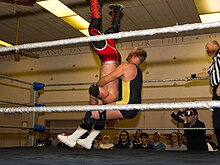
Piledriver
The name is taken from a piece of construction equipment, also called a pile driver, that drives countless massive impacts on the top of a large major foundation support, burying it in the ground slowly with each impact. The act of performing a piledriver is called "piledriving." Someone who has recently been the victim of a piledriver is said to have been "piledriven" (e.g. "The wrestler was piledriven into the canvas").
Labels: Sport
Wednesday, February 1, 2012
Gordie Howe
Gordon "Gordie" Howe, OC (born March 31, 1928) is a Canadian retired professional ice hockey player who played for the Detroit Red Wings and Hartford Whalers of the National Hockey League (NHL), and the Houston Aeros and New England Whalers in the World Hockey Association (WHA). Howe is often referred to as Mr. Hockey, and is generally regarded as one of the greatest hockey players of all time. Howe is most famous for his scoring prowess, physical strength, and career longevity. He is the only player to have competed in the NHL in five (1940s through 1980s) different decades. A four-time Stanley Cup champion with the Red Wings, he won six Hart Trophies as the league's most valuable player and six Art Ross Trophies as the leading scorer. He was the recipient of the first NHL Lifetime Achievement Award in 2008.
Howe was also referred to during his career as Power, Mr. Everything, Mr. All-Star, The Most, The Great Gordie, The King of Hockey, The Legend, The Man, No. 9, and "Mr. Elbows" (for his tough physical play). His name and nickname, "Mr. Hockey", as well as his wife's nickname as "Mrs. Hockey", are registered trademarks.
Howe was born to parents Ab and Kate Howe in a farmhouse in Floral, Saskatchewan – one of nine children. When Gordie was nine days old, the Howes moved to Saskatoon, where his father worked as a labourer during the Depression. In the summers, Howe would work construction with his father. Howe was mildly dyslexic growing up, but was physically beyond his years at an early age. He began playing organized hockey at 8 years old, then left Saskatoon at 16 to pursue his hockey career.
Howe was an ambidextrous player, able to use the straight sticks of his era to shoot left or right-handed. He received his first taste of pro experience at fifteen years old when he was invited to a tryout for the New York Rangers in Brooklyn, but he did not make the team. A year later, he was noticed by Detroit Red Wings scout Fred Pinckney. He was signed by the Red Wings and assigned to their junior team in Galt, Ontario. However, due to a maximum amount of Western players allowed by the league and a preference to develop older players by the Red Wings, Howe's playing time with the team was initially limited.
Howe made his NHL debut in 1946 at the age of 18, playing right wing for the Detroit Red Wings, for which he wore #17 as a rookie. When Roy Conacher moved on to the Chicago Black Hawks after the 1946–47 season, however, Howe was offered Conacher's #9 which he would wear for the rest of his career.
Howe led Detroit to four Stanley Cups and to first place in regular season play for seven consecutive years (1948–49 to 1955–56), a feat never equaled in NHL history. During this time Howe and his linemates, Sid Abel and Ted Lindsay, were known collectively as "The Production Line", both for their scoring and as an allusion to Detroit auto factories. The trio dominated the league in such a fashion that in 1949–50, they finished one-two-three in league scoring.
The Red Wings were consistently contenders throughout the 1950s and early 1960s but began to slump in the late 60s. When Howe turned 40, in 1967–68, the league expanded from six to twelve teams and the number of scoring opportunities grew as the game schedule increased. Howe played the 1968–69 season on a line with Alex Delvecchio and Frank Mahovlich. Mahovlich was big, fast, and skilled, and Delvecchio was a gifted playmaker. The three were dubbed "The Production Line 3" and at forty-years-old, Howe reached new scoring heights, topping 100 points for the only time of his NHL career with 44 goals and a career-high 59 assists.
Howe remained with the Red Wings for two more seasons, but after twenty-five years, a chronic wrist problem forced him to retire after the 1970–71 season and he took a job in the Red Wings front office. At the beginning of 1972, he was offered the job as first head coach of the New York Islanders, but turned it down.[10]
A year later, he was offered a contract to play with the Houston Aeros of the newly formed World Hockey Association, who had also signed his sons Mark and Marty to contracts. Dissatisfied with not having any meaningful influence in the Red Wings' office, he underwent an operation to improve his wrist and make a return to hockey possible, and he led his new team to consecutive championships. In 1974, at the age of 46, Howe won the Gary L. Davidson Trophy, awarded to the WHA's most valuable player (the trophy was renamed the Gordie Howe Trophy the following year). Howe played with the Aeros until 1977, when he and his sons joined the New England Whalers.
When the WHA folded in 1979, the renamed Hartford Whalers joined the NHL. While the Red Wings still held his NHL rights even though he'd retired eight years earlier, the Whalers and Red Wings reached a gentlemen's agreement in which the Red Wings agreed not to reclaim him. The 51-year-old Howe signed on for one final season playing in all 80 games of the schedule, helping his team to make the playoffs with fifteen goals. One particular honor was when Howe, Phil Esposito, and Jean Ratelle were selected to the mid-season all-star game by coach Scotty Bowman, as a nod to their storied careers before they retired. Howe had played in five decades of all-star games and he would skate alongside the second-youngest to ever play in the game, 19-year-old Wayne Gretzky. The Joe Louis Arena crowd gave him a standing ovation twice, lasting so long, he had to skate to the bench to stop people from cheering. He had one assist in the Whalers' 6–3 win.
Howe became good friends with Wayne Gretzky, who had idolized Howe as a young player, and who would later break many of Howe's scoring records and milestones.
Another milestone in a remarkable career was reached in 1997 when Howe played professional hockey in a sixth decade. He was signed to a one-game contract by the Detroit Vipers of the IHL and, almost 70-years-old, made a return to the ice for one shift. In doing so, he became the only player in hockey history to compete in six different decades at the professional level, having played in the NHL, WHA and IHL from the 1940s to 1990s.
At the time of his retirement, Howe's professional totals, including playoffs, for the NHL and WHA combined, were first. He finished with 2,421 games played, 1,071 goals, 1,518 assists, and 2,589 points. Wayne Gretzky has since passed him in goals (1,072), assists (2,297), and points (3,369), but not games played (1,767) or games played with one team (1,687). It is unlikely that anyone will surpass Howe's total professional games played.
In 1998, The Hockey News released their List of Top 100 NHL Players of All Time and listed Howe third overall, ahead of Mario Lemieux, but behind Wayne Gretzky and Bobby Orr.
Tuesday, October 4, 2011
50 Metre Rifle Prone
50 metre rifle prone is an International Shooting Sport Federation event, based on the traditional English Match. The match consists of 60 shots from the prone position with a .22 Long Rifle (5.6 mm) caliber rifle. The time limit is 75 minutes for the entire match including sighting shots, or 90 minutes if there is a need to compensate for slow scoring systems. Only the men's event is included on the Olympic program and thus includes a final for the top eight competitors, where the score zones are divided into tenths, giving up to 10.9 points for each shot. The final consists of ten shots, with a time limit of 45 seconds per shot. The competition is won by the shooter who reaches the highest aggregate score (qualification + final, maximum 709.0).
The women's event is not Olympic but included in both the ISSF and the CISM World Championships. As there is no final, shooters with the same score are separated by a number of tie-breaking criteria, the first being the number of inner tens. Women's rifles may weigh up to 6.5 kilograms (14 lb), as opposed to 8 kilograms (18 lb) for men, but after the switch from standard rifles to sport rifles this is now the only difference in equipment.
Labels: Sport
Tuesday, September 20, 2011
Peter Puck
Peter Puck is a hockey puck-shaped cartoon character. The puck, whose animated adventures appeared on both NBC's Hockey Game of the Week and CBC's Hockey Night in Canada during the 1970s, explained ice hockey rules, equipment and the sport's history to the home viewing audience. The voice of Peter Puck was provided by Ronnie Schell; the animation was produced by Hanna-Barbera studios. Nine episodes, each approximately three minutes long, were broadcast between periods of NHL hockey games.The brainchild of NBC executive and New York Rangers season ticket holder Donald Carswell, who conceived the idea and scripted first drafts of the initial episodes, Peter Puck was developed for the television network in partnership with Hanna-Barbera. Designed to help introduce and popularize ice hockey among non-fans (especially children), Peter Puck became an instant and enduring hit with existing hockey fans. When they stopped carrying NHL games in 1975, NBC sold Peter's rights back to Hanna-Barbera, which later sold them to Brian McFarlane, a member of the network's NHL broadcast team (and the son of Leslie McFarlane, also known as author Franklin W. Dixon of Hardy Boys fame.)
Peter Puck made a comeback during the 2007 NHL Playoffs, as retailers began selling a line of retro apparel with the Peter Puck logo. That same year, PeaceArch Entertainmentreleased the entire series to DVD.
Since December 2007, the original Peter Puck has been shown during the first intermission of Toronto Maple Leafs games broadcast on Leafs TV. The clips are seen in their original form, with outdated rules and references omitted.
For the 2009-10 NHL season, Peter Puck returned to the CBC. He can usually be seen during the pre-game show, often known as Scotiabank Hockey Tonight but sometimes between games that make up the traditional doubleheader.
Labels: Cartoons, Characters, Sport
Saturday, September 3, 2011
Nickel Trophy
The two universities sit approximately 76 miles apart on the eastern border of the state. The Nickel Trophy is an over sized 75 pound replica of the James Earle Fraser-designed U.S. buffalo nickel with a buffalo on one side representing NDSU Bison and a Native American head on the other side representing UND Fighting Sioux. The late Robert Kunkel, a UND alumnus and Chicago advertising executive, was the originator of the trophy.
The coin shaped trophy's "mint" date is 1937, the year the trophy was created. The Nickel is 250 times larger than a regular five-cent piece and weighs 75 pounds. Inaugurated in 1938, it is 2 inches thick and 22 inches in diameter, and has been the object of many theft attempts by students from both universities.
The first "official" game for the Nickel occurred in 1938 when NDSU won by a 17-13 score. Both teams have had long winning streaks in the series. The most recent streaks of significant length were in 1981-1992, where the Bison won 12 straight games in the series, including two shutout wins (1985 and 1989)- and in 1993-1996, where the Sioux snapped the losing streak by winning four straight regular season games. (As mentioned, the two teams did play playoff games in 1994 and 1995 respectively- the Sioux winning in 1994 and the Bison in 1995). Of more historical note, the Sioux won 12 straight also from 1953-1964 before the Bison stopped the streak with a 6-3 win in 1965.
In 2002, NDSU announced their intention to move their football program to the Division I-AA level (and athletic program as a whole to Division I). An agreement for the schools to continue competing on the field could not be reached between the two universities and was the subject of much controversy following NDSU's reclassification. Thus, the Sioux have held the trophy since October 18, 2003, when they defeated NDSU in the last Nickel Trophy game by a 28-21 score in Grand Forks.
In mid-2006, UND announced their intention to move their football program to the Division I-AA level as well, and it is hoped by many alumni of both schools that the rivalry may resume by the end of the decade on an annual basis.
Labels: Sport
Wednesday, August 24, 2011
Curse of the Colonel
Curse of the Colonel refers to an urban legend regarding a reputed curse placed on the Japanese Kansai-based Hanshin Tigers baseball team by deceased KFC founder and mascot Colonel Harland Sanders. The curse was said to be placed on the team because of the Colonel's anger over treatment of one of his store-front statues. The Hanshin Tigers are located in Kansai, the second largest metropolitan area in Japan. They are considered the eternal underdogs of Nippon Professional Baseball, in opposition to the Yomiuri Giants of Tokyo, who are considered the kings of Japanese baseball. The devoted fans flock to the stadium no matter how badly the Tigers play in the league.
As is common with sports-related curses, the Curse of the Colonel is used to explain the Japan Championship Series drought that the Hanshin Tigers have had to endure since their first and only victory in the 1985 Japan Championship. The curse is said to have happened when Hanshin fans, excited over winning the 1985 championship series, tossed the statue of Colonel Sanders into the Dōtonbori River.
In 1985, the Hanshin Tigers faced the Seibu Lions and took their first and only victory in the Japan Series, largely due to star slugger Randy Bass, a gaijin (foreigner) player for the team.
The rabid fan base went wild, and a riotous celebration gathered at Ebisubashi Bridge in Dōtonbori, Osaka. There, an assemblage of supporters yelled the players names, and with every name a fan resembling a member of the victorious team leapt from the bridge into the waiting canal. However, lacking someone to imitate MVP Randy Bass, the rabid crowd seized a Colonel Sanders (like Bass, the Colonel had a beard and was not Japanese) plastic statue from a nearby KFC and tossed it off the bridge as an effigy.
The Colonel was finally discovered in the Dōtonbori River on March 10, 2009. Divers who recovered the statue at first thought it was only a large barrel, and shortly after a human corpse, but Hanshin fans on the scene were quick to identify it as the upper body of the long-lost Colonel. The right hand and lower body were found next day, but the statue is still missing its glasses and left hand.
Saturday, August 13, 2011
Sons of the Thames
Sons of the Thames is a rowing club in Hammersmith, London, England. It was originally formed in Putney over a hundred years ago with the aim, still enshrined in its constitution, to further the sport of rowing.Originally a Trademen's club who boated from their first premises at the Dukes Head in Putney, Sons has moved westwards to Hammersmith. The latest move, in 2000, was to share the premises of Linden House, on Upper Mall, with London Corinthian Sailing Club. The building has a 999 year lease, so another move is not expected soon. The club welcomes novices and more experienced members for their Henley squads.
The club's official founding date is 1886, however there is evidence of crews racing under the "Sons of the Thames" name at least as far back as 1865.
Labels: Organizations, Sport
Friday, June 24, 2011
Chuck Taylor
Charles Hollis "Chuck" Taylor (June 24, 1901 – June 23, 1969) was an American basketball player and shoe salesman/evangelist. He is best known for his association with the Chuck Taylor All-Stars sneaker, the most successful selling basketball shoe in history.The Converse All-Star shoe, which on the bottom says "one star", one of the first especially designed to be worn when playing basketball, was introduced in the 1910s. Taylor started wearing them in 1917 as a high school basketball player. In 1921, Taylor went to the Converse Shoes Chicago sales offices in search of a job, where S.R. "Bob" Pletz, an avid sportsman, then hired him.
Within a year, Taylor's suggestions of changing the design of the shoe to provide enhanced flexibility and support, and also including patch to protect the ankle, were adopted. The All-Star star logo was then immediately included on the patch. By 1923 Chuck Taylor's name was added to the patch, and the shoe became the Chuck Taylor All-Stars.
Chuck Taylor was an exceptional representative for Converse. Joe Dean, who worked as a sales executive for Converse for nearly 30 years before becoming the athletic director at Louisiana State University, told Bob Ford of The Philadelphia Inquirer, "It was impossible not to like him, and he knew everybody. If you were a coach and you wanted to find a job, you called Chuck Taylor. Athletic directors talked to him all the time when they were looking for a coach."
Taylor received a salary from Converse, but received no commission for any of the 600 million pairs of Chuck Taylor shoes that have been sold. For years, he drove a white Cadillac across the country with a trunk full of shoes, living in motels, and with only a locker in the company's Chicago warehouse as a permanent residence. Author Abraham Aamidor, however, points out that Taylor wasn't sparing in use of the Converse expense account.
Taylor promoted basketball internationally; it became an Olympic sport in 1936. White high-tops originated in 1947 for the 1948 Olympics.
During WWII, Taylor became fitness consultant for the US military. GIs were soon doing calisthenics whilst wearing Chuck Taylor sneakers that had become the official sneaker of the US Armed Forces.
By 1966 Converse had a 80% of the US sneaker market. In 1968, Taylor retired. Just one day short of his 68th birthday in June 1969 Taylor died of a heart attack in Port Charlotte, Florida.
Saturday, February 5, 2011
Pace Car
In motorsport, a pace car is a car which limits the speed of competing cars on a racetrack in the case of a caution period such as an obstruction on the track. During a caution period the pace car enters the track ahead of the leader. Competitors are not allowed to pass the pace car or other competitors during a caution period, and the pace car leads the field at a pre-determined safe speed, which may vary by series and circuit. At the end of the caution period, the pace car leaves the track and the competitors may resume racing.
Labels: Automobiles, Sport
Thursday, November 25, 2010
Leon Lett
Leon Lett, Jr. is a former star American football defensive tackle in the National Football League who played for the Dallas Cowboys (1991–2000) and the Denver Broncos (2001), after playing college football at Emporia State University. Lett was a two-time Pro Bowler, with selections in 1994 and 1998. He wore jersey number 78 and was 6'6, 292 pounds during his playing days. He is best remembered for two infamous plays in Cowboys' team history.Lett was a talented player and a cornerstone of the Cowboys defense during his tenure, but fans likely remember him for his infamous plays. Two of the top three of ESPN's "25 Biggest Sports Blunders" are attributed to Lett. The fans ranked him #1 and #3, whereas an expert panel placed him at #2 and #3.
The first play (ranked #1 in the ESPN fan list, #2 in the ESPN expert panel) occurred in January 1993, in Super Bowl XXVII. Late in the fourth quarter, Lett recovered a fumble on Buffalo's 45 yard line and ran it back towards the endzone. When he reached the 10 yard line, he slowed, and held the ball out as he approached the goal line. However, he didn't see a hustling Don Beebe, chasing him down from behind. Beebe knocked the ball out of Lett's outstretched hand just before he crossed the goal line, which sent the ball through the endzone, and resulted in a touchback that cost Lett his touchdown. Lett later said he was watching the Jumbotron, and trying to do a "Michael Irvin", where he put the ball out across the goal line.
The Cowboys had a commanding 52–17 lead at the time, and the play did not affect the outcome of the game, but it certainly embarrassed Lett, and it is still well known by football fans today. Lett's gaffe also cost the Cowboys the record for most points scored in a Super Bowl (55, by the San Francisco 49ers in Super Bowl XXIV).
The second play (ranked #3 in both ESPN lists) occurred during the very next season and was actually more serious as it resulted in a Cowboy defeat. On Thanksgiving Day in 1993, during a rare snow and sleet storm in Dallas, the Cowboys, who came into the game with a 7-3 record, were leading the 8-2 Miami Dolphins 14–13 with 15 seconds remaining in the game. The Dolphins attempted a 41-yard field goal to take the lead but the kick was blocked. While most of his teammates began celebrating, Lett attempted to recover the ball. He slipped on the ice as he tried to pick up the football, and Miami recovered the "muff" on the Dallas one yard line. Had Lett simply done nothing, the Cowboys would have automatically received possession and could have run out the clock. By touching the ball and then failing to hold onto it, Lett enabled the Dolphins to take possession and then try another field goal with 3 seconds left on the clock. This second attempt was successful and the Dolphins won the game 16–14 as the clock expired. The play actually didn't hurt the Cowboys' season as they won all of their remaining regular-season games and went on to win the Super Bowl, whereas the Dolphins (who took over sole possession of the lead in the AFC East with the win) would not win another game for the rest of the year, dropping their last five games and finishing out of the playoffs. In 2008, the game was named the third-most memorable in the history of Texas Stadium by ESPN.
Tuesday, June 8, 2010
Bench-Clearing Brawl
A bench-clearing brawl, sometimes known as a basebrawl or a rhubarb, is a form of ritualistic fighting that occurs in sports, most notably baseball and ice hockey, in which both teams leave their dugouts, bullpens, or benches and charge the playing area in order to fight one another.In baseball, brawls are usually the result of escalating infractions, often stemming from a player being hit by a pitch, or an altercation between a baserunner and infielder stemming from excessive contact in an attempted tag out (such as a runner crashing into the catcher at home plate in an attempt to dislodge the ball). They are also known to occur when a batter charges the mound. However, few bench-clearing brawls result in serious injury, as in most cases, no punches are thrown, and the action is limited to pushing and shoving.
Since a bench-clearing brawl by definition involves everyone on both teams, it is exceedingly unlikely that all participants will be ejected, but the player or players responsible for the precipitating event are almost universally ejected.
Fighting in ice hockey by enforcers is an established, if unofficial, part of the sport (especially in North America, where the penalty rules are more permissive); the general procedure in a one-on-one fight is to let it pan out and then send both players to the penalty box with five-minute major penalties. Bench-clearing brawls are more serious, and prohibited.
As in baseball, hockey brawls usually result from escalating infractions; in this case, dangerous hits, excessive post-whistle roughness, taking shots after the whistle, attacking the goaltender, and accumulated hatred from fierce competition in a game with a significant amount of condoned inter-player violence, all contribute to bench-clearing brawls.
In the National Hockey League the penalties include, in addition to in-game penalties, an automatic 10-game suspension and a fine of $10,000 for the first player to leave his bench or the penalty box to participate in a brawl; for the second player to leave his bench or the penalty box, the penalties include, in addition to in-game penalties, an automatic five-game suspension and a fine of $5,000.
Bench-clearing brawls have also been known to occur in other sports, and officials in those sports have been cracking down on such brawls; in 1995, the National Basketball Association changed the penalty for leaving the bench to participate in a brawl from a $500 fine to an automatic one-game suspension.
Labels: Sport
Monday, November 9, 2009
The Wave
The wave is achieved in a packed stadium when successive groups of spectators briefly stand and raise their arms. Each spectator is required to rise at the same time as those straight in front and behind, and slightly after the person immediately to either the right (for a clockwise wave) or the left (for a counterclockwise wave). Immediately upon stretching to full height, the spectator returns to the usual seated position. The result is a "wave" of standing spectators that travels through the crowd, even though individual spectators never move away from their seats. In many large arenas the crowd is seated in a contiguous circuit all the way around the sport field, and so the wave is able to travel continuously around the arena; in discontiguous seating arrangements, the wave can instead reflect back and forth through the crowd. When the gap in seating is narrow, the wave can sometimes pass through it. Usually only one wave crest will be present at any given time in an arena. Simultaneous, counter-rotating waves have been produced.
Although it was not associated with sports, Frank Zappa is credited by some with inventing a precursor to the wave in 1969 at the Denver Pop Festival in Denver Mile High Stadium when he assigned sounds and gestures to sections of the crowd and sequenced them with hand gestures. He conducted with the audience making sounds. He would conduct waves of one, two, or three sounds at the same time. He then commented, "You guys are pretty good, you ought to get a band together and call yourselves Denver". He then walked offstage to end the performance. The exact origin of the wave is disputed. Its growth may be traced to five different sports, across three different North American countries, and Russia.
- Some claim that it was created (by chance) at a National Hockey League game in Canada in 1980, and introduced to a wider audience (intentionally) in October 1981 at a Major League Baseball game in Oakland, California, and at an American football game in Seattle, Washington.[citation needed]
- The wave is also believed to have been created in Vancouver, British Columbia by a marketing campaign for the local soccer team the Vancouver Whitecaps, in which they got the crowd to perform this for a commercial in which their slogan was "Catch the Wave."[citation needed]
There are other reports that claim that in the 1960s, in Monterrey Mexico, during a game between Tigres and Rayados, the wave was created in the half time. The crowd was anxious, and the organizers were doing games and throwing football balls as presents in the half time because players took a lot of time returning to the field. That made people start doing the wave.
Whatever its origin, by the mid-1980s the practice was widespread throughout North America. Finally, it gained worldwide notice, and the specific name Mexican wave, during the FIFA Football World Cup in Mexico at the Estadio Universitario in Monterrey, 1986.
In 2002, Tamás Vicsek of the Eötvös Loránd University, Hungary along with his colleagues analyzed videos of 14 waves at large Mexican football stadiums, developing a standard model of wave behavior (published in the September 12 issue of Nature). He found that it takes only the actions of a few dozen fans to trigger a wave. Once started, it usually rolls in a clockwise direction at a rate of about 12 m/s (40 ft/s), or about 22 seats per second. At any given time the wave is about 15 seats wide. These observations appear to be applicable across different cultures and sports, though details vary in individual cases.
Wednesday, September 2, 2009
Moe Berg
Morris "Moe" Berg, an American catcher and coach in Major League Baseball who later served as a spy for the Office of Strategic Services during World War II. Although he played 15 seasons in the major leagues, almost entirely for four American League teams, Berg was never more than an average player, usually used as a backup catcher, and was better known for being "the brainiest guy in baseball" than for anything he accomplished in the game. Casey Stengel once described Berg as "the strangest man ever to play baseball". A graduate of Princeton University and Columbia Law School, Berg spoke several languages and regularly read 10 newspapers a day. His reputation was fueled by his successful appearances as a contestant on the radio quiz show Information, Please! in which he answered questions about the derivation of words and names from Greek and Latin, historical events in Europe and the Far East, and ongoing international conferences.
As a spy working for the government of the United States, Berg traveled to Yugoslavia to gather intelligence on resistance groups the U.S. government was considering supporting. He was then sent on a mission to Italy, where he interviewed various physicists concerning the German nuclear program.
Most notably, Berg was assigned the task of attending a lecture by German physicist Werner Heisenberg in Zurich, Switzerland to determine "if anything Heisenberg said convinced him the Germans were close to a bomb." If Berg came to the conclusion that the Germans were close, he had orders to shoot Heisenberg; Berg determined that the Germans were not close.
After the war, Berg was occasionally employed by the OSS's successor, the Central Intelligence Agency, but, by the mid-1950s, was unemployed. He spent the last two decades of his life without work, living with various siblings.
Wednesday, July 29, 2009
Noodling
Noodling is a southern US practice of fishing for catfish using only bare hands. Many other names, such as catfisting, grabbling, graveling, hogging, dogging, gurgling, tickling and stumping, are used in different regions for the same activity. Noodling is currently legal in eleven states. Although the concept, catching fish with only the use of the arm in the water, is simple enough, the process of noodling is more complicated. The choice of catfish as the prey is not arbitrary, but comes from the circumstances of their habitat. Flathead catfish live in holes or under brush in rivers and lakes and thus are easy to capture due to the static nature of their dwelling. To begin, a noodler goes underwater to depths ranging from only a few feet to up to twenty feet, placing his hand inside a discovered catfish hole. If all goes as planned, the catfish will swim forward and latch onto the fisherman's hand, usually as a defensive maneuver in order to try to escape the hole. If the fish is particularly large, the noodler can hook the head around its gills.
Most noodlers have spotters who help them bring the catfish in, either to shore or to their boat. When a catfish bites onto a noodler, it holds on for quite a while.
With some of the biggest fish caught weighing in at up to 50-60 pounds, very few noodlers are strong enough to attempt noodling by themselves. Although carrying the fish after they have been subdued is not difficult, trying to secure a fish and remove it from one's hand at the same time can be a challenge.
Tuesday, July 28, 2009
Split
A split is a situation in ten pin bowling in which the first ball of a frame knocks down the headpin (i.e., the "number 1" pin) but leaves standing two or more non-adjacent groups of one or more pins.The most infamous of splits is the 7–10 split, often called "goal posts" or "bedposts", where the bowler is left with the leftmost and the rightmost pin in the back row (the number 7 and number 10) to knock down with a single ball to achieve a spare.
The only way to pick this up is to let a pin fly back from the pit area. This is very difficult to achieve by itself as a pin flying out from the pit is a fairly rare occurrence. Sliding the pin directly will not work since the ball will fall off the lane before it gets far enough aside the 7 or 10 pin to slide it directly across.
It is sometimes possible to slide the 7 pin onto the 10 pin by using a bowling ball which comes into contact with the 7 pin just before dropping into the gutter (usually the ball would be on the 1st or 2nd board near the gutter at the point of contact). There is nearly no margin for error in order to achieve this and the contact must be made before the ball enters the gutter or it would be considered an illegal spare.
Labels: Sport
Friday, July 24, 2009
Perfect Game
A perfect game is defined by Major League Baseball as a game in which a pitcher (or combination of pitchers) pitches a victory that lasts a minimum of nine innings and in which no opposing player reaches base. Thus, the pitcher (or pitchers) cannot allow any hits, walks, hit batters, or any opposing player to reach base safely for any other reason—in short, "27 up, 27 down". The feat has been achieved only 18 times in the history of major league baseball—16 times since the modern era began in 1900.The first confirmed use of the term "perfect game" was in 1908; the current official definition of the term was formalized in 1991. Although it is possible for multiple pitchers to combine for a perfect game (as has happened nine times at the major league level for a no-hitter), to date, every major league perfect game has been thrown by a single pitcher.
Labels: Sport