Tuesday, April 13, 2010

Robert Greene

Robert Greene was an English author best known today for a posthumously published pamphlet attributed to him, Greene's Groats-Worth of Wit, which may contain a polemic attack on William Shakespeare. He was born in Norwich and attended Cambridge University, receiving a BA in 1580, and a MA in 1583 before moving to London, where he arguably became the first professional author in England. Greene published in many genres including autobiography, plays, and romances, while capitalizing on a scandalous reputation.

Greene was born in Norwich in 1558; however biographers disagree as to whether Greene was the son of a humble saddler, or a more prosperous innkeeper with land-owning relatives. He took his B.A. in 1580 and his M.A. in 1583 at St John's College, Cambridge, and became an M.A. of Oxford in 1588. Greene claimed to have married a well-off woman named Doll, and to have later abandoned her, after spending a considerable sum of her money.

In London, Greene became a principal member of the loose association known as the University Wits, and managed to support himself through his own writing. He lived as a notorious intellectual and rascal, cultivating this reputation himself in pamphlets describing his adventures amid the seamier characters of Elizabethan England, and through a memorable appearance, with fashionable clothing and his pointy red beard.

He died on 3 September 1592, from what his contempoary Thomas Nashe called a "banquet of Rhenish wine and pickled herring," perhaps having written on his death bed the famous Groatsworth of Wit Bought with a Million of Repentance and having dispatched a letter to his wife asking her to forgive him and to settle his debts.

Monday, April 12, 2010

Boilermaker

A boilermaker is a beer cocktail consisting of a glass of beer and a shot of whiskey, tequila, or vodka. The beer is either served as a chaser or is mixed with the liquor. When the beer is served as a chaser, the drink is often called simply “a shot and a beer.”

In the United Kingdom, a boilermaker is a shot of bourbon or rye whiskey dropped into a glass of English pale ale.

There are various ways to drink a boilermaker:

“Generally speaking, the Boilermaker is merely a glass of beer with a shot of whiskey served on the side. The shot goes down in one, and the beer follows, being sipped rather than quickly downed.”

  • Traditionally, the liquor is drunk in a single gulp and is chased by the beer.
  • The liquor and beer may be mixed by pouring or dropping the shot into the beer. The mixture may be stirred, if desired.
  • The liquor may be poured directly into an open beer can after removing some of the beer.
Variations:
  • A Poktanju (Korean for “bomb drink”) is made by dropping a shot of whiskey or soju into a pint of Korean beer.[5][6] It is sometimes called a Soju Bomb by English-speakers.
  • An October Crisis is a variant in which a dash of maple syrup is added to the whiskey before being dropped into the beer. Traditionally done with Labatt 50 and Canadian Club Whiskey.
  • A Wh'basco is a variant in which a shot of whiskey is poured into a pint of beer, and a dash of Tabasco sauce is added.
  • An Irish Car Bomb is a variant in which approximately half a shot of Irish whiskey is floated over half a shot of cream liqueur and dropped into a pint of stout.
  • A Lunch Box is a variant in which a shot of Amaretto is dropped into a glass of beer topped off with orange juice. The final product's taste resembles that of the popular drink Hawaiian Punch.
  • A Flaming Dr Pepper is a variant in which a shot of Amaretto is topped with 151 proof rum and set on fire. The "flaming" shot is dropped into a glass of beer. The final product's taste resembles that of the popular soft drink in its title.

Sunday, April 11, 2010

Wu-Tang Clan

The Wu-Tang Clan are a New York City-based hip-hop group, which consists of: RZA, GZA, Method Man, Raekwon, Ghostface Killah, Inspectah Deck, U-God, Masta Killa, and the late Ol' Dirty Bastard. They are frequently joined by fellow childhood friend Cappadonna, whose status as an official member is in dispute. They were formed in (and are associated with) the New York City borough of Staten Island (referred to by members as "Shaolin"), though some of their members are from Brooklyn.

They have introduced and launched the careers of affiliated artists and groups, often collectively known as the Wu-Tang Killa Bees. In 2007, MTV ranked Wu-Tang the 5th greatest Hip-hop group of all time.

The founders of the Wu-Tang Clan were cousins Robert Diggs, Gary Grice, Russell Jones (RZA, GZA, and Ol' Dirty Bastard respectively) who had formed the group Force of the Imperial Master (later known as All in Together Now after the release of a popular single by that name). The group attracted the attention of figures in the industry, including Biz Markie, but did not manage to secure a record deal.

Wu-Tang Clan was assembled in late 1992 with RZA as the de facto leader and the group's producer. The name "Wu-Tang" is derived from the name of the mountain Wu Dang (Wudang Shan) in northwest Hubei Province in central China with long history associated with Chinese culture, especially Taoism, martial arts and medicine. The RZA and Ol' Dirty Bastard adopted the name for the group after the film Shaolin and Wu Tang. The group's debut album loosely adopted a Shaolin vs. Wu-Tang theme, dividing the album into Shaolin and Wu-Tang sections.

Saturday, April 10, 2010

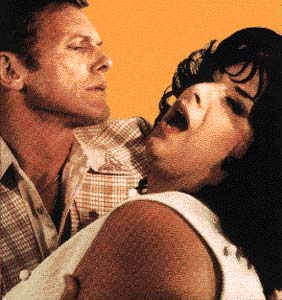
Polyester

Polyester is a 1981 American John Waters comedy film starring Divine, Tab Hunter, Edith Massey, and Mink Stole. It was filmed in Waters' native Baltimore, Maryland, and features a gimmick called "Odorama", whereby viewers could smell what they saw on screen through scratch and sniff cards.

The film is a satire of suburban life involving divorce, abortion, adultery, alcoholism, foot fetishism, and the Religious Right.

Polyester was meant as a send-up of “women’s pictures,” an exploitative genre of film that was popular from the 1950s-60s and typically featured bored, unfulfilled, or otherwise troubled women, usually middle-aged suburban housewives, finding release or escape through the arrival of a handsome younger man. “Women’s pictures” were typically hackneyed B-movies, but Waters specifically styled Polyester after the work of the director Douglas Sirk, making use of similar lighting and editing techniques, even using film equipment and movie-making techniques from Sirk's era.

Friday, April 9, 2010

Sigurd Eysteinsson

Sigurd Eysteinsson (aka Sigurd the Mighty, ruled circa 875–92) was the second Viking Earl of Orkney, who succeeded his brother Rognvald Eysteinsson. He was a leader in the Viking conquest of what is now northern Scotland. Bizarrely, he was killed by the severed head of one his enemies, Máel Brigte, who may have been mórmaer of Moray. Sigurd strapped Máel Brigte's head to his saddle as a trophy of conquest, and as he rode, Máel Brigte's teeth grazed against Sigurd's leg. The wound became infected and Sigurd died.

According to the Orkneyinga saga, towards the end of his reign, Sigurd challenged a native ruler, Máel Brigte the Bucktoothed, to a 40-man-a-side battle. Treacherously, Sigurd brought 80 men to the fight. Máel Brigte was defeated and beheaded. Sigurd strapped the head to his saddle as a trophy, but as Sigurd rode, Máel Brigte's buck-tooth scratched his leg. The leg became inflamed and infected, and as a result Sigurd died. He was buried in a tumulus known as Sigurd's Howe, or Sigurðar-haugr, from the Old Norse word haugr meaning mound or barrow. The location of Sigurd's Howe is most probably modern-day Sidera or Cyderhall near Dornoch.

Sigurd's death was apparently followed by a period of instability. He was succeeded by his son Guttorm, who died within a few months. Rognvald made his son Hallad Earl of Orkney, but Hallad could not contain the pirate Vikings, resigned his earldom and returned to Norway in disgrace. The sagas say that Rognvald's other sons were more interested in conquering places other than Scotland, and so the earldom was given to Rognvald's youngest son, Einarr.


Thursday, April 8, 2010

London Beer Flood

The London Beer Flood occurred on October 17, 1814 in the London parish of St. Giles in the United Kingdom. At the Meux and Company Brewery on Tottenham Court Road, a huge vat containing over 135,000 imperial gallons (610,000 L) of beer ruptured, causing other vats in the same building to succumb in a domino effect. As a result, more than 323,000 imperial gallons (1,470,000 L) of beer burst out and gushed into the streets. The wave of beer destroyed two homes and crumbled the wall of the Tavistock Arms Pub, trapping teenaged employee Eleanor Cooper under the rubble.

The brewery was located among the poor houses and tenements of the St Giles Rookery, where whole families lived in basement rooms that quickly filled with beer. Eight people drowned in the flood, and one person died from alcohol poisoning the next day.

The brewery was eventually taken to court over the accident, but the disaster was ruled to be an Act of God by the judge and jury, leaving no one responsible. The company found it difficult to cope with the financial implications of the disaster, with a significant loss of sales made worse because they had already paid duty on the beer. They made a successful application to Parliament reclaiming the duty which allowed them to continue trading.

The brewery was demolished in 1922, and today, the Dominion Theatre occupies a part of the site of the former brewery.

Wednesday, April 7, 2010

Basil

Basil (Ocimum basilicum), of the family Lamiaceae (mints), is a tender low-growing herb. Basil is a culinary herb prominently featured in Italian cuisine, and also plays a major role in the Southeast Asian cuisines of Thailand, Vietnam, Cambodia, and Laos. The plant tastes somewhat like anise, with a strong, pungent, sweet smell.

There are many varieties of basil. That which is used in Italian food is typically called sweet basil, as opposed to Thai basil, lemon basil and holy basil, which are used in Asia. While most common varieties of basil are treated as annuals, some are perennial in warm, tropical climates, including African Blue and Holy Thai basil.

Basil is originally native to Iran, India and other tropical regions of Asia, having been cultivated there for more than 5,000 years.

The word basil comes from the Greek basileus, meaning "king", as it is believed to have grown above the spot where St. Constantine and Helen discovered the Holy Cross. The Oxford English Dictionary quotes speculations that basil may have been used in "some royal unguent, bath, or medicine". Basil is still considered the "king of herbs" by many cookery authors.

Tuesday, April 6, 2010

Ludovico Technique

The Ludovico technique is a fictional drug-assisted aversion therapy from the novel and film A Clockwork Orange. It involves the patient being forced to watch violent images for long periods of time, while under the effect of drugs that cause a near death experience. The idea is that if the patient is forced to watch the horribly graphic rapes, assaults and other acts of violence while suffering from the drug effects, the patient will assimilate the sensations and then become incapacitated or very ill either attempting to perform or even just witnessing said acts of violence.

The Ludovico technique is an artistic semblance of the psychological phenomenon known as classical conditioning which is a form of associative learning that was first demonstrated by Ivan Pavlov. The typical procedure for inducing classical conditioning involves presentations of a neutral stimulus along with a stimulus of some significance. The neutral stimulus could be any event that does not result in an overt behavioral response from the organism under investigation. In the story of A Clockwork Orange, when the protagonist, Alex, is made the subject of the Ludovico technique, he is conditioned to associate his illness with violence.

In the process of creating both the novel and film adaptation of A Clockwork Orange, original author Anthony Burgess and film director Stanley Kubrick both went to painstaking effort to incorporate a plethora of symbols for the context of the story.

Monday, April 5, 2010

Joseph Ducreux

Joseph Ducreux was a French portrait painter, pastelist, miniaturist, and engraver. Born in Nancy, Ducreux may have trained with his father, who was also a painter. Ducreux went to Paris in 1760, and trained as the only student of pastelist Maurice-Quentin de La Tour, who specialized in portraiture. In terms of Ducreux's oil technique, Jean-Baptiste Greuze also served as an important influence as his instructor.

Ducreux specialized in portrait painting, and his early portraits were done in pastel, and include those done of the connoisseurs Pierre-Jean Mariette, the Comte de Caylus and Ange-Laurent de la Live de July. These works may have been copies after De La Tour.

Ducreux also made several well-known self-portraits in the late 1780s, including one in which he painted himself in the middle of a large yawn (which currently hangs in the Getty Center) and another of himself guffawing and pointing at the viewer (which hangs in the Louvre). As evidenced by these self-portraits, Ducreux attempted to break free from the constraints of traditional portraiture. Interested in physiognomy, which is based on the belief that the study and judgment of a person's outer appearance, primarily the face, reflects their character or personality, Ducreux attempted to capture the personality of his subjects - as well as his own - through his warm and individualistic works. Le Discret (ca. 1790), for example, is the portrait of a man asking for silence. His expression is timorous, his finger is pressed against his mouth in alarm as he silently demands discretion or prudence.

In 1769, he was sent to Vienna in order to paint a miniature of Marie-Antoinette before she left the city in 1770 and married Louis XVI of France. Ducreux was made a baron and premier peintre de la reine (First Painter to the Queen) in rewards for his services. Ducreux was given this appointment by Marie-Antoinette even though he was not a member of the Royal Academy of Painting and Sculpture.

At the outbreak of the French Revolution, Ducreux traveled to London. There he drew the last portrait ever made of Louis XVI before the king's execution.

Other portraits by Ducreux include those done of Pierre Choderlos de Laclos and Maria Theresa of Austria.

Recently, Ducreux and his work have gone through a cultural renaissance as a result of his eccentric self-portrait being extensively used in an internet meme, featuring “archaic reinterpretation” of popular rap lyrics superimposed over the artwork. This highly verbose joke provides the challenge of “decoding” the corrupted lyrics back into to the original verses.

Sunday, April 4, 2010

My War

My War is the second full length album by the American hardcore punk band Black Flag. It was released in 1984 on SST Records.

Black Flag's founder and primary songwriter Greg Ginn played bass guitar in addition to his usual guitar; "Dale Nixon" (credited for playing bass on the album) is a pseudonym.

My War was released after a long period where the band could not release any albums due to a legal dispute with Unicorn Records.

The first six songs on the a-side of My War are similar to the material on 1981's Damaged, but the three songs on the b-side proved that Black Flag was moving away from the band's early, fast-paced material. The b-side songs are played at about half the pace of the band's earlier material, each clocking in at over six minutes, and display a doomy, ominous sound indebted to Black Sabbath. My War is generally cited as being a major influence on many bands in the sludge metal and grunge genres. Two of the songs featured on the album are solely written by Chuck Dukowski (My War, I Love You) though he was no longer a member of the band by this point and does not perform on the album.