Tuesday, April 20, 2010

Tetrahydrocannabinol

Tetrahydrocannabinol, also known as delta-9-tetrahydrocannabinol (Δ9-THC), Δ1-THC (using an older chemical nomenclature), or dronabinol, is the main psychoactive substance found in the cannabis plant.

It was first isolated by Raphael Mechoulam, Yechiel Gaoni, and Habib Edery from the Weizmann Institute of Science in Rehovot, Israel, in 1964. In pure form, it is a glassy solid when cold and becomes viscous and sticky if warmed. An aromatic terpenoid, THC has a very low solubility in water, but good solubility in most organic solvents.

Like most pharmacologically-active secondary metabolites of plants, THC in cannabis is assumed to be involved in self-defense, perhaps against herbivores. THC also possesses high UV-B (280-315 nm) absorption properties, which, it has been speculated, could protect the plant from harmful UV radiation exposure.

Dronabinol is the International Nonproprietary Name (INN) for a pure isomer of THC, (-)-trans-Δ9-tetrahydrocannabinol, that is, the main isomer in cannabis. It is sold as Marinol (a registered trademark of Solvay Pharmaceuticals). Dronabinol is also marketed, sold, and distributed by PAR Pharmaceutical Companies under the terms of a license and distribution agreement with SVC pharma LP, an affiliate of Rhodes Technologies.

Monday, April 19, 2010

Know Nothing

The Know Nothing movement was a nativist American political movement of the 1840s and 1850s. It was empowered by popular fears that the country was being overwhelmed by German and Irish Catholic immigrants, who were often regarded as hostile to U.S. values and controlled by the Pope in Rome. Mainly active from 1854 to 1856, it strove to curb immigration and naturalization, though its efforts met with little success. There were few prominent leaders, and the largely middle-class and entirely Protestant membership fragmented over the issue of slavery. Most ended up joining the Republican Party by the time of the 1860 presidential election.

The movement originated in New York in 1843 as the American Republican Party. It spread to other states as the Native American Party and became a national party in 1845. In 1855 it renamed itself the American Party. The origin of the "Know Nothing" term was in the semi-secret organization of the party. When a member was asked about its activities, he was supposed to reply, "I know nothing."

Sunday, April 18, 2010

Chakra

Chakra is a Sanskrit word that translates as "wheel" or "turning".

Chakra is a concept referring to wheel-like vortices which, according to traditional Indian medicine, are believed to exist in the surface of the etheric double of man. The Chakras are said to be "force centres" or whorls of energy permeating, from a point on the physical body, the layers of the subtle bodies in an ever-increasing fan-shaped formation (the fans make the shape of a love heart). Rotating vortices of subtle matter, they are considered the focal points for the reception and transmission of energies. Seven major chakras or energy centres (also understood as wheels of light) are generally believed to exist, located within the subtle body.

It is typical for chakras to be depicted as either flower-like or wheel-like. In the former, a specific number of petals are shown around the perimeter of a circle. In the latter, a certain number of spokes divide the circle into segments that make the chakra resemble a wheel or chakra. Each chakra possesses a specific number of segments or petals.

Texts documenting the chakras go back as far as the later Upanishads, for example the Yoga Kundalini Upanishad.

Saturday, April 17, 2010

Nian

In Chinese mythology, a Nian is a beast that lives under the sea or in the mountains. Once each spring, on or around Chinese New Year, it comes out of hiding to attack people, especially children. The Nian is sensitive to loud noises and is afraid of the color red.

The Chinese Lion Dance is known to have originated from the legend of the Nian. The tradition began when a Nian attacked a village. After the attack, the villagers discussed how to make the Nian leave them alone. Eventually they came up with a plan where drums, plates and empty bowls were hit and firecrackers were thrown, causing loud banging sounds that would scare off the Nian. This scared the Nian, and since that time, the Nian has not appeared in the village again.

The Nian is still believed to exist, but that it is scattered about the jungle and mountains, never to appear in front of a human again.

Friday, April 16, 2010

Central Grocery

Central Grocery is a small, old-fashioned Italian-American grocery store with a sandwich counter located at 923 Decatur Street, in the French Quarter of New Orleans, Louisiana. It was founded in 1906 by Salvatore Lupo, a Sicilian immigrant. He operated it until 1946 when he retired and his son-in-law, Frank Tusa took over the operation. Today it is owned by Salvatore T. Tusa, Salvatore's grandson and two cousins. The store was one of many family owned, neighborhood grocery stores during the early 20th century, when the French Quarter was still predominantly a residential area. Though tourists are more common in Central now, it has retained much of its old world market feel.

It is famous as the home of the New Orleans muffuletta sandwich invented by Salvatore Lupo, to feed the Sicilian truck farmers who sold their produce at the Farmer's Market on Decatur Street in the French Quarter. The Muffuletta was only locally known until the late 1960s. Now, it has international fame. The Central sells not only the sandwiches as take-out or eat-in, but also the ingredients of the muffuletta—including olive salad by the jar—for people who want to make the sandwich at home. Because of the muffuletta, they were featured on the PBS special Sandwiches That You Will Like and "The Today Show" [five best sandwiches series].

Central Grocery also sells Italian, Greek, French, Spanish, and Creole table delicacies. They also carry less mainstream selections, such as chocolate covered grasshoppers and bumble bees in soy sauce, which are perennially displayed in the store front windows.

Wednesday, April 14, 2010

Melpomène

Melpomène, initially the Muse of Singing, she then became the Muse of Tragedy, for which she is best known now. Her name was derived from the Greek verb melpô or melpomai meaning "to celebrate with dance and song." She is often represented with a tragic mask and wearing the cothurnus, boots traditionally worn by tragic actors. Often, she also holds a knife or club in one hand and the tragic mask in the other. On her head she is shown wearing a crown of cypress.

Melpomene is the daughter of Zeus and Mnemosyne. Her sisters include Calliope (muse of epic poetry), Clio (muse of history), Euterpe (muse of lyrical poetry), Terpsichore (muse of dancing), Erato (muse of erotic poetry), Thalia (muse of comedy), Polyhymnia (muse of hymns), and Urania (muse of astronomy).

In Roman and Greek poetry, it was traditional to invoke the goddess Melpomene so that one might create beautiful lyrical phrase.

Tuesday, April 13, 2010

Robert Greene

Robert Greene was an English author best known today for a posthumously published pamphlet attributed to him, Greene's Groats-Worth of Wit, which may contain a polemic attack on William Shakespeare. He was born in Norwich and attended Cambridge University, receiving a BA in 1580, and a MA in 1583 before moving to London, where he arguably became the first professional author in England. Greene published in many genres including autobiography, plays, and romances, while capitalizing on a scandalous reputation.

Greene was born in Norwich in 1558; however biographers disagree as to whether Greene was the son of a humble saddler, or a more prosperous innkeeper with land-owning relatives. He took his B.A. in 1580 and his M.A. in 1583 at St John's College, Cambridge, and became an M.A. of Oxford in 1588. Greene claimed to have married a well-off woman named Doll, and to have later abandoned her, after spending a considerable sum of her money.

In London, Greene became a principal member of the loose association known as the University Wits, and managed to support himself through his own writing. He lived as a notorious intellectual and rascal, cultivating this reputation himself in pamphlets describing his adventures amid the seamier characters of Elizabethan England, and through a memorable appearance, with fashionable clothing and his pointy red beard.

He died on 3 September 1592, from what his contempoary Thomas Nashe called a "banquet of Rhenish wine and pickled herring," perhaps having written on his death bed the famous Groatsworth of Wit Bought with a Million of Repentance and having dispatched a letter to his wife asking her to forgive him and to settle his debts.

Monday, April 12, 2010

Boilermaker

A boilermaker is a beer cocktail consisting of a glass of beer and a shot of whiskey, tequila, or vodka. The beer is either served as a chaser or is mixed with the liquor. When the beer is served as a chaser, the drink is often called simply “a shot and a beer.”

In the United Kingdom, a boilermaker is a shot of bourbon or rye whiskey dropped into a glass of English pale ale.

There are various ways to drink a boilermaker:

“Generally speaking, the Boilermaker is merely a glass of beer with a shot of whiskey served on the side. The shot goes down in one, and the beer follows, being sipped rather than quickly downed.”

  • Traditionally, the liquor is drunk in a single gulp and is chased by the beer.
  • The liquor and beer may be mixed by pouring or dropping the shot into the beer. The mixture may be stirred, if desired.
  • The liquor may be poured directly into an open beer can after removing some of the beer.
Variations:
  • A Poktanju (Korean for “bomb drink”) is made by dropping a shot of whiskey or soju into a pint of Korean beer.[5][6] It is sometimes called a Soju Bomb by English-speakers.
  • An October Crisis is a variant in which a dash of maple syrup is added to the whiskey before being dropped into the beer. Traditionally done with Labatt 50 and Canadian Club Whiskey.
  • A Wh'basco is a variant in which a shot of whiskey is poured into a pint of beer, and a dash of Tabasco sauce is added.
  • An Irish Car Bomb is a variant in which approximately half a shot of Irish whiskey is floated over half a shot of cream liqueur and dropped into a pint of stout.
  • A Lunch Box is a variant in which a shot of Amaretto is dropped into a glass of beer topped off with orange juice. The final product's taste resembles that of the popular drink Hawaiian Punch.
  • A Flaming Dr Pepper is a variant in which a shot of Amaretto is topped with 151 proof rum and set on fire. The "flaming" shot is dropped into a glass of beer. The final product's taste resembles that of the popular soft drink in its title.

Sunday, April 11, 2010

Wu-Tang Clan

The Wu-Tang Clan are a New York City-based hip-hop group, which consists of: RZA, GZA, Method Man, Raekwon, Ghostface Killah, Inspectah Deck, U-God, Masta Killa, and the late Ol' Dirty Bastard. They are frequently joined by fellow childhood friend Cappadonna, whose status as an official member is in dispute. They were formed in (and are associated with) the New York City borough of Staten Island (referred to by members as "Shaolin"), though some of their members are from Brooklyn.

They have introduced and launched the careers of affiliated artists and groups, often collectively known as the Wu-Tang Killa Bees. In 2007, MTV ranked Wu-Tang the 5th greatest Hip-hop group of all time.

The founders of the Wu-Tang Clan were cousins Robert Diggs, Gary Grice, Russell Jones (RZA, GZA, and Ol' Dirty Bastard respectively) who had formed the group Force of the Imperial Master (later known as All in Together Now after the release of a popular single by that name). The group attracted the attention of figures in the industry, including Biz Markie, but did not manage to secure a record deal.

Wu-Tang Clan was assembled in late 1992 with RZA as the de facto leader and the group's producer. The name "Wu-Tang" is derived from the name of the mountain Wu Dang (Wudang Shan) in northwest Hubei Province in central China with long history associated with Chinese culture, especially Taoism, martial arts and medicine. The RZA and Ol' Dirty Bastard adopted the name for the group after the film Shaolin and Wu Tang. The group's debut album loosely adopted a Shaolin vs. Wu-Tang theme, dividing the album into Shaolin and Wu-Tang sections.

Saturday, April 10, 2010

Polyester

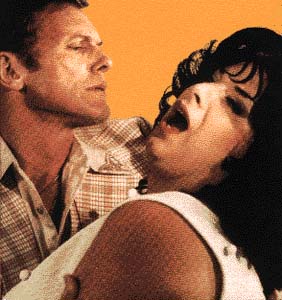
Polyester is a 1981 American John Waters comedy film starring Divine, Tab Hunter, Edith Massey, and Mink Stole. It was filmed in Waters' native Baltimore, Maryland, and features a gimmick called "Odorama", whereby viewers could smell what they saw on screen through scratch and sniff cards.

The film is a satire of suburban life involving divorce, abortion, adultery, alcoholism, foot fetishism, and the Religious Right.

Polyester was meant as a send-up of “women’s pictures,” an exploitative genre of film that was popular from the 1950s-60s and typically featured bored, unfulfilled, or otherwise troubled women, usually middle-aged suburban housewives, finding release or escape through the arrival of a handsome younger man. “Women’s pictures” were typically hackneyed B-movies, but Waters specifically styled Polyester after the work of the director Douglas Sirk, making use of similar lighting and editing techniques, even using film equipment and movie-making techniques from Sirk's era.