Monday, May 10, 2010

"Shipwreck" Kelly

John Simms "Shipwreck" Kelly (July 8, 1910 – August 17, 1986) was a professional American football player who played halfback in the National Football League. He played five seasons for the New York Giants (1932) and the Brooklyn Dodgers (1933-1937). Kelly became a player-coach and later a player/coach/owner with the Dodgers football club, the successor to the Dayton Triangles, a charter member of the NFL. The Dodgers, through a couple of reorganizations, became the Baltimore Colts, now the Indianapolis Colts.

Kelly's real claim to fame was his 1941 marriage, in New York City, to the "Millionaire Debutante" Brenda Frazier, after whom the long-running comic strip Brenda Star was modeled. The couple bought a new Packard Darrin convertible off the floor of the New York Auto Show, and palled around NYC with the likes of Jock Whitney and Tom Kerrigan. They were married for fifteen years, and had one daughter. in 1956 he married Catherine Hannon. They had 2 children John Kelly and Victoria.

During World War II, Kelly was recruited by the FBI to travel to Cuba, Mexico, Peru, Chile and Argentina to track the activities of wealthy German expatriates helping the Nazi cause.

After the war, Kelly pursued a career as an investment banker, Florida real estate investor and became a champion amateur golfer. He died of a stroke at age 76 and is buried in his home town of Simstown, Kentucky.

Sunday, May 9, 2010

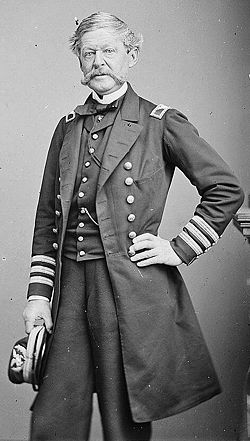
Cadwalader Ringgold

Cadwalader Ringgold was an officer in the United States Navy who served in the United States Exploring Expedition, later headed an expedition to the Northwest and, after initially retiring, returned to service during the Civil War.

Ringgold was born in Washington County, Maryland, at "Fountain Rock", the 18,000-acre estate of his father, Samuel Ringgold, a Maryland politician who later served in the U.S. House of Representatives.

He entered the U.S. Navy in 1819 and commanded the schooner Weazel in action against West Indies pirates during the late 1820s. He became a lieutenant May 17, 1828 and that year served on Vandalia in the Pacific. He went on to serve on the Adams in the Mediterranean.
During 1838-42, he participated in the Wilkes Expedition in the Pacific, commanding Porpoise from 1840 at the invitation of the head of the project, Charles Wilkes.

When the expedition visited Fiji, they captured Vendoni, a chief on the islands who had inspired some Fijians to capture and eat 11 crewmen on a ship seven years before. Soon afterward, Fijians on the island of Malolo ambushed and killed two officers of the expedition, and the Americans took revenge. Wilkes' ship grounded on the north side of the island, but Ringgold led 80 men from the south side. Women and children were spared, but about 87 Fijians were killed before the rest surrendered. Two villages were destroyed.

The expedition visited California that summer. On August 19, 1841, Ringgold led a 60-man party exploring San Francisco Bay watershed for 20 days. The party got about as far as Colusa, California. Ringgold, who returned to New York shortly after the rest of the expedition, had been gone three years and 11 months at sea. He and his crew had sailed 95,000 miles (153,000 km) and lost only two men.

He was promoted to commander on July 16, 1849 and began the definitive survey of the San Francisco Bay region, suddenly important because of the discovery of gold in the area. The survey began in August 1849, with Ringgold commanding the chartered brig Col. Fremont.

In 1853 he took command of the North Pacific Exploring and Surveying Expedition, also known as the Rodgers-Ringgold Expedition, but while on the expedition, in July 1854, he became sick with malaria and was sent home, according to at least one source. John Rodgers was given full command of the expedition and completed it. For the next several years, he was in Washington, D.C., working on the North Pacific Exploring and Surveying Expedition charts, some of which were later used by the U. S. Navy as late as World War II.

He returned to the fleet with the rank of captain during the Civil War. While in command of the frigate Sabine on November 1, 1861, he effected the rescue of a battalion of 400 Marines from Maryland whose transport steamer, Governor, was sinking during a severe storm near Port Royal, South Carolina.

In February 1862, he was a part of the search and rescue of the ship of the line Vermont which had lost her rudder in a storm. For these rescues, Ringgold received commendations from the Maryland Legislature and the U.S. Congress, along with a gold medal from the Life Saving Benevolent Association.

Promoted to commodore on July 16, 1862, he was sent (still on the Sabine), to cruise the Azores, Cape Verde Islands, the coast of Brazil and then back to New York in a fruitless search for the Confederate raider CSS Alabama from November 1862 to February 1863. In mid-1863, Ringgold's assignment was to search (again unsuccessfully) in the vicinity of Bermuda and then the New England coast for the bark Tacony, another Confederate raider.

He retired on August 20, 1864, and was placed on the rear admiral (retired) list in 1866 (a promotion that was given to all commanders of squadrons). In retirement, he lived at 18 East Eighteenth Street in New York City. He died of a stroke on April 29, 1867.

Two ships have been named in his honor: USS Ringgold (DD-89), and USS Ringgold (DD-500).

Saturday, May 8, 2010

April In Paris

"April in Paris" is a song composed by Vernon Duke with lyrics by E. Y. Harburg in 1932 for the Broadway musical, Walk A Little Faster. It has been performed by many artists, including Louis Armstrong, Count Basie, Bill Evans, Charlie Parker, Coleman Hawkins, Frank Sinatra, Mary Kaye Trio, Billie Holiday, Thelonious Monk, Ella Fitzgerald, Benny Goodman, Dinah Shore, Glenn Miller, Doris Day, Alex Chilton, Tommy Dorsey, Blossom Dearie, Wynton Marsalis and Dawn Upshaw. The original 1933 hit was performed by Freddy Martin, the 1952 remake (inspired by the movie of the same name) was by the Sauter-Finegan Orchestra, whose version made the Cashbox Top 50.

Basie's 1955 recording is the most famous, and that particular performance was inducted into the Grammy Hall of Fame. On this recording, trumpeter Thad Jones played his famous "Pop Goes the Weasel" solo, and Basie directs the band to play the shout chorus "one more time," then "one more once."

Friday, May 7, 2010

Perseus

Perseus, the legendary founder of Mycenae and of the Perseid dynasty there, was the first of the mythic heroes of Greek mythology whose exploits in defeating various archaic monsters provided the founding myths of the Twelve Olympians. Perseus was the Greek hero who killed Medusa and claimed Andromeda, having rescued her from a sea monster.

Because of the obscurity of the name Perseus and the legendary character of its bearer, most etymologists pass it by, on the presumption that it might be pre-Greek. However, the name of Perseus’s native city was Greek and so were the names of his wife and relatives. Perseus might be from the ancient Greek verb, perthein, “to waste, ravage, sack, destroy”, some form of which appears in Homeric epithets. According to Carl Darling Buck (Comparative Grammar of Greek and Latin), the –eus suffix is typically used to form an agent noun, in this case from the aorist stem, pers-. Pers-eus therefore is a sacker of cities; that is, a soldier by occupation, a fitting name for the first Mycenaean warrior.

Thursday, May 6, 2010

M16

The M16 (more formally Rifle, Caliber 5.56 mm, M16) is the United States military designation for the AR-15 rifle. Colt purchased the rights to the AR-15 from ArmaLite and currently uses that designation only for semi-automatic versions of the rifle. The M16 rifle fires the 5.56x45mm cartridge and can produce massive wounding and hydrostatic shock effects when the bullet impacts at high velocity and yaws in tissue leading to fragmentation and rapid transfer of energy. However, terminal effects can be unimpressive when the bullet fails to yaw or fragment in tissue.

The M16 entered United States Army service as the M16A1 and was put into action for jungle warfare in South Vietnam in 1963, becoming the standard U.S. rifle of the Vietnam War by 1969; replacing the M14 rifle in that role. The U.S. Army retained the M14 in CONUS, Europe, and South Korea until 1970. Since the Vietnam War, the M16 rifle family has been the primary infantry rifle of the U.S. military. With its variants, it has been in use by 15 NATO countries, and is the most produced firearm in its caliber.

Wednesday, May 5, 2010

Butterscotch

Butterscotch is a type of confectionery whose primary ingredients are brown sugar and butter. Other ingredients such as corn syrup, cream, vanilla, and salt are typically part of the recipe also. The ingredients for butterscotch are similar to toffee; the major difference is that the sugar is boiled to the soft crack stage for butterscotch and the hard crack stage for toffee. Butterscotch sauce is often made into a syrup, which is used as a topping for ice cream (particularly sundaes).

The term butterscotch is also often used, such as in the names of recipes, for the flavours brown sugar and butter together where the actual confection butterscotch is not involved, e.g. butterscotch pudding.

Food historians have several theories regarding the name and origin of this confectionery, but none are conclusive. One explanation is the meaning "to cut or score" for the word "scotch", as the confection must be cut into pieces, or "scotched", before hardening.[1][2] It is also possible that the "scotch" part of its name was derived from the word "scorch".

However, the word was first recorded in Doncaster, in England, where Samuel Parkinson began making the confectionery in 1817. Parkinson's Butterscotch had royal approval and was one of Doncaster's attractions until it ceased production in 1977. The recipe was revived in 2003 when a Doncaster businessman and his wife rediscovered the recipe on an old folded piece of paper inside one of the famous St Leger tins in their cellar.

It is often used as a flavour for items such as dessert sauce, pudding, and biscuits. To that end, it can be bought in "butterscotch chips", made with hydrogenated (solid) fats so as to be similar for baking use to chocolate chips. There are also individually wrapped, translucent sometimes yellow colored hard candies with an artificial butterscotch flavour, which is dissimilar to actual butterscotch.

Tuesday, May 4, 2010

Flying Boat

A flying boat is a fixed-winged seaplane with a hull, allowing it to land on water. It differs from a float plane as it uses a purpose-designed fuselage which can both float, granting the aircraft buoyancy, and give aerodynamic sheath. Flying boats may be stabilized by under-wing floats or by wing-like projections from the fuselage. Flying boats were some of the largest aircraft of the first half of the 20th century, superseded in size only by bombers developed during World War II. Their advantage lay in using water instead of expensive land-based runways, making them the basis for international airlines in the mid-war period. They were also commonly used for maritime patrol and air-sea rescue.

The craft class or type came about after The Daily Mail offered a large monetary prize for an aircraft with transoceanic range in 1914 prompting a collaboration between British and American air pioneers, resulting in the Curtiss Model H. Following World War II, their use gradually tailed off, partially because of the investments in airports during the war. In the 21st century, flying boats maintain a few niche uses, such as for dropping water on forest fires and for air transport around archipelagos, wilderness access in wilder undeveloped territories such as lands north of South Dakota and roadless regions of Central Africa. Many modern seaplane variants, whether float or flying boat types are convertible amphibians—planes where either landing gear or flotation modes may be used to land and take off.

Monday, May 3, 2010

The Third of May 1808

The Third of May 1808 is a painting completed in 1814 by the Spanish master Francisco Goya, now in the Museo del Prado, Madrid. In the work, Goya sought to commemorate Spanish resistance to Napoleon's armies during the occupation of 1808. Along with its companion piece of the same size, The Second of May 1808 (or The Charge of the Mamelukes), it was commissioned by the provisional government of Spain at Goya's suggestion.

On 2 May 1808, provoked by news of the planned removal to France of the last members of the Spanish royal family, the people of Madrid rebelled in the Dos de Mayo Uprising. The Third of May illustrates the French reprisals: before dawn the next day hundreds of Spaniards were rounded up and shot, at a number of locations around Madrid.

The Third of May 1808 is set in the early hours of the morning following the uprising and centers on two masses of men: one a rigidly poised firing squad, the other a disorganized group of captives held at gun point. Executioners and victims face each other abruptly across a narrow space; according to Kenneth Clark, "by a stroke of genius [Goya] has contrasted the fierce repetition of the soldiers' attitudes and the steely line of their rifles, with the crumbling irregularity of their target." A square lantern situated on the ground between the two groups throws a dramatic light on the scene. The brightest illumination falls on the huddled victims to the left, whose numbers include a monk or friar in prayer. To the immediate right and at the center of the canvas, other condemned figures stand next in line to be shot. The central figure is the brilliantly lit man kneeling amid the bloodied corpses of those already executed, his arms flung wide in either appeal or defiance. His yellow and white clothing repeats the colors of the lantern.

On the right side stands the firing squad, engulfed in shadow and painted as a monolithic unit. Seen nearly from behind, their bayonets and their shako headgear form a relentless and immutable column. Without distracting from the intensity of the foreground drama, a townscape with a steeple looms in the nocturnal distance, probably including the barracks used by the French. In the background between the hillside and the shakos is a crowd with torches: perhaps onlookers, perhaps more soldiers or victims.

The painting's content, presentation, and emotional force secure its status as a groundbreaking, archetypal image of the horrors of war. Although it draws on many sources from both high and popular art, The Third of May 1808 marks a clear break from convention. Diverging from the traditions of Christian art and traditional depictions of war, it has no distinct precedent, and is acknowledged as one of the first paintings of the modern era. According to the art historian Kenneth Clark, The Third of May 1808 is "the first great picture which can be called revolutionary in every sense of the word, in style, in subject, and in intention".

The Third of May 1808 has inspired a number of other major paintings, including a series by Édouard Manet, and Pablo Picasso's Massacre in Korea as well as his masterpiece Guernica.

Sunday, May 2, 2010

Chitty Bang Bang

Chitty Bang Bang was the informal name of a number of celebrated English racing cars, built and raced by Count Louis Zborowski and his engineer Clive Gallop in the 1920s, which inspired the book, film and stage musical Chitty Chitty Bang Bang.

The Chittys were built and stored at Higham Park, Zborowski's country house at Bridge near Canterbury in Kent. The cars were so loud that Canterbury reportedly passed a by-law prohibiting them from entering within the city walls. The origin of the name "Chitty Bang Bang" is disputed, but is believed to have come from a salacious World War I song.

Chitty 1 was a chain-driven customised Mercedes chassis containing a 23 litre 6 cylinder Maybach aero-engine. It won two races at its debut at Brooklands in 1921, coming second to another Zborowski car in a sprint race at the same event. Chitty 1 was fitted with four seats and a crude, over-sized exhaust pipe, in order to misguide the handicappers and spectators. Its top speed on the day was 100.75 miles per hour (162.14 km/h).

For its next outing, Chitty 1 was refitted, as a two-seater with a cowled radiator and a properly plumbed exhaust. It attained nearly 120 mph (190 km/h) on one occasion, and had its race handicap consistently reappraised. It subsequently crashed, removing three fingers from a timing official. The car was rebuilt, and passed into the ownership of the sons of Arthur Conan Doyle, but was quickly retired as a racing car, and was later butchered for spare parts.

Chitty 2 had a shorter wheelbase, an 18.8 litre Benz Bz.IV aero-engine and the coachwork was carried out by Bligh Brothers of Canterbury, England. It was never as successful as its predecessor, but took part in several road races, including a Sahara Desert expedition in 1922. It later became the property of the Crawford Auto-Aviation Museum in Cleveland, Ohio. It is now part of the private collection of Bob Bahre at his home in Paris Hill, Maine (the former mansion of Hannibal Hamilin, Lincoln's first Vice-President).

Chitty 3 was based on a modified Mercedes chassis with a 160 hp (120 kW) Mercedes single overhead camshaft six cylinder aero engine, tuned to produce 180 hp (130 kW). The car recorded a lap of Brooklands at 112.68 mph (181.34 km/h). Louis Zborowski later used it as his personal transport, and drove it to Stuttgart when he negotiated to join the Mercedes racing team.

Chitty 4 (also known as the Higham Special) was Louis Zborowski's largest car yet. Using a 450 hp (340 kW) V12 Liberty aero engine of 27 litres capacity, with a gearbox and chain-drive from a pre-war Blitzen Benz, it was the largest capacity racing car ever to run at Brooklands. Still not fully developed by the time of Zborowski's death in November 1924, it was purchased from his estate by J.G. Parry-Thomas for the sum of £125.

Parry-Thomas rechristened the car Babs and rebuilt it with four Zenith carburettors and his own design of pistons. In April 1926, Parry-Thomas used the car to win the Land speed record at 171.02 mph (273.6 km/h). However, he was killed in the vehicle in a later attempt on 3 March 1927. Babs was buried at Pendine Sands in Wales, but was later recovered and restored and is now on display at the Pendine Museum of Speed.


Saturday, May 1, 2010

Karl Marx

Karl Heinrich Marx was a German philosopher, political economist, historian, political theorist, sociologist, communist, and revolutionary, whose ideas are credited as the foundation of modern communism. Marx summarized his approach in the first line of chapter one of The Communist Manifesto, published in 1848: "The history of all hitherto existing society is the history of class struggles." Marx argued that capitalism, like previous socioeconomic systems, would inevitably produce internal tensions which would lead to its destruction. Just as capitalism replaced feudalism, he believed socialism would, in its turn, replace capitalism, and lead to a stateless, classless society called pure communism. This would emerge after a transitional period called the "dictatorship of the proletariat": a period sometimes referred to as the "workers state" or "workers' democracy".

Marx argued that socio-economic change occurred through organized revolutionary action. He argued that capitalism will end through the organized actions of an international working class: "Communism is for us not a state of affairs which is to be established, an ideal to which reality will have to adjust itself. We call communism the real movement which abolishes the present state of things. The conditions of this movement result from the premises now in existence."

While Marx remained a relatively obscure figure in his own lifetime, his ideas and the ideology of Marxism began to exert a major influence on workers' movements shortly after his death. This influence gained added impetus with the victory of the Bolsheviks in the Russian October Revolution in 1917, and few parts of the world remained significantly untouched by Marxian ideas in the course of the twentieth century. Marx is typically cited as one of the principal architects of modern social science.