Showing posts with label Music. Show all posts

Thursday, February 28, 2013

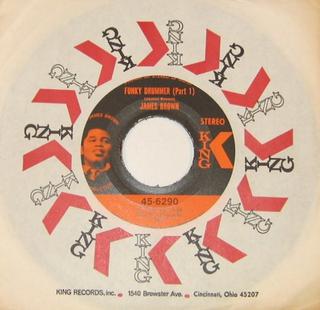
Funky Drummer

"Funky Drummer" is a funk song recorded by James Brown and his band. The recording's drum break, performed by drummer Clyde Stubblefield, is one of the most frequently sampled rhythmic breaks in hip hop and popular music; indeed, it lays a strong claim to being the most sampled recording ever, along with the Amen Break.

"Funky Drummer" was recorded on November 20, 1969 in Cincinnati, Ohio and originally released by King Records as a two-part45 rpm single in March 1970. Despite rising to #20 on the R&B chart and #51 on the pop chart, it did not receive an album release until the 1986 compilation In the Jungle Groove.


The piece takes the form of an extended vamp, with individual instruments (mostly the tenor saxophones and organ) improvising brief licks on top. Brown's ad-libbed vocals on "Funky Drummer" are sporadic and declamatory, and are mostly concerned with encouraging the other band members.

As in the full-length version of "Cold Sweat" he announces the upcoming drum break, which comes late in the recording, with a request to "give the drummer some." He tells Stubblefield "You don't have to do no soloing, brother, just keep what you got... Don't turn it loose, 'cause it's a mother." Stubblefield's eight-bar unaccompanied "solo", a version of the riff he plays through most of the piece, is the result of Brown's directions; this break beat is one of the most sampled recordings in music.

After the drum break, the band returns to the original vamp. Brown, apparently impressed with what Stubblefield has produced, seems to name the song on the spot as it continues, and repeats it: "The name of this tune is 'The Funky Drummer', 'The Funky Drummer', 'The Funky Drummer'." The recording ends with a reprise of Stubblefield's solo and a fade-out.

Thursday, May 3, 2012

Black Randy and the Metrosquad

Black Randy and the Metrosquad was a punk rock act from the late 1970s and early 1980s in the Los Angeles punk scene. They gained notoriety not only for their surreal and smutty sense of humour, but also for their amalgamation of proto-punk, 1970s soul, pop, and avant-garde music.

The band formed in Los Angeles in 1977 with Black Randy (born John Morris) as front man, David Brown on keyboards, and other members including Pat Garrett on guitar, who later joined The Dils. However, the band had a rotating line-up, which even included live back-up singers known as the Blackettes which often included Alice Bag, Exene Cervenka, Lorna Doom, Jane Wiedlin, Belinda Carlisle and featured several members of The Eyes.

Black Randy's lyrics gave him a reputation for being as witty as he was offensive with songs about gay prostitution, Marlon Brando, and Idi Amin. Their first single, "Trouble at the Cup", advocated fighting the police, though this (like all their material) was as tongue in cheek as his cover of James Brown's classic "Say It Loud - I'm Black and I'm Proud". Some saw this cover as an offensive reinterpretation of the song as a mocking attack on black pride (considering that Black Randy was white); others saw it as irreverent, ironic, and humorous. The band also covered the theme from the cult Blaxploitation film Shaft, by Isaac Hayes, in the same irreverent manner.

These songs were compiled onto their only album, Pass the Dust, I Think I'm Bowie, which had sophisticated and even innovative musical arrangements that had more in common with post-punk than hardcore bands like Black Flag.

The band imploded early in 1980 when their frontman succumbed to drug and alcohol problems, which were evident in chaotic live shows, where songs were hardly sung and Brown tried, to no avail, to salvage the show. Black Randy died on November 11th, 1988

Sunday, March 18, 2012

Vox Phantom

The Vox Phantom is an electric guitar, originally released in 1962 by the Jennings company. It is unique for its distinctive, pentagonal shape, which became part of the iconic representation of the British Invasion. Originally made in England, manufacturing was later relocated to Italy.
Features of the Vox Phantom included 2 or 3 single-coil pickups, open-back tuners, and a Tune-o-matic bridge inspired by similar Gibson bridges. Later models included a Bigsby-inspired tremolo, designed by Vox's founder, Thomas Jennings. It included a round leather-coated pad on the back for comfort while playing. A 12-string version, the Phantom XII, was also made. Both 6 and 12 string guitars were also made as "Stereo" versions; capable of operating in stereo with a special cable which connected to two ampflifiers simultaneously. This enabled complex panning and switching effects that were in vogue as Psychedelic rock was popular.
Another variant of the Phantom guitars was the "Special". This included on board effects such as fuzz, Tremolo, and repeat percussion. Effects were operated by a series of push buttons along the bottom neck side of the pick guard.
The guitar shared many of the practical problems of similar unusually-shaped guitars, such as Gibson's Flying V. Its shape made it difficult to play sitting down, and its polyester finish scratched easily at its corners.
Numerous copies of the Vox Phantom's distinctive five-sided body design were manufactured, by companies such as Teisco and Kawai under the Domino brand name. Contemporary copies are also manufactured by companies such as Eastwood Guitars (called the VG6) and Jay Turser (called the Phantasia). Jack Charles of Phantom Guitarworks continues to build excellent replicas of this and other VOX models.
The 1998 USA VOX Reissue Phantoms, Teardrops and Mando Guitars were designed and produced by John Hawkins of North Coast Music who had been an existing VOX/KORG supplier since 1992. Various components including necks, pickups, finishing and hardware for the guitars were produced through existing North Coast vendors such as LaSido. Final assembly was subcontracted to a small Minnesota based builder, Kevin Smith of Tonesmith guitars.
For 2011 VOX reintroduced the Phantom in its Apache series. The travel guitar hosts a 2-channel guitar amplifier, speakers, several rhythm patterns, and an E-String tuner.

Sunday, March 11, 2012

Zolar X

Zolar X is a proto-punk glam rock band, established in 1973, recently staging a comeback.
From 1973 to 1981 Zolar X became legendary on the west coast USA for dressing and acting like space-aliens 24 hours a day. They spoke ceaselessly in an "alien language" of their own invention, which would amuse, but often infuriate the public at large. They are referred to as "Los Angeles' first glam rock band" in the 1998 book Glam by Barney Hoskyns. Zolar X's origin is included in author Marc Spitz and Brendan Mullen's quintessential 2001 book on the Los Angeles punk scene We Got The Neutron Bomb.

In the 1970s, Zolar X's outlandish image was matched by over the top performances, otherworldly stage sets, and their unique brand of glitter-space-rock. They were the house band at famed Los Angeles nightclub Rodney Bingenheimer's English Disco, which was recently immortalized in George Hickenlooper's 2004 documentary Mayor Of The Sunset Strip. Zolar X played historic gigs with Iggy Pop, Michael Des Barres, Jobriath, New York Dolls, among others. Ace Frehley of Kiss was a Zolar X fan and early supporter.

Wednesday, February 29, 2012

Laibach

Laibach is a Slovenian avant-garde music group strongly associated with industrial, martial, and neo-classical musical styles. Formed June 1, 1980 in Trbovlje, Slovenia (then Yugoslavia), Laibach represents the music wing of the Neue Slowenische Kunst (NSK) art collective, of which it was a founding member in 1984. The name "Laibach" is the German name for Slovenia's capital city, Ljubljana.

Laibach is known for their cover versions, which are often used to subvert the original message or intention of the song — a notable example being their version of the song "Live is Life" by Opus, an Austrian arena rock band. Whereas the original is a feel-good pop anthem, Laibach's subversive interpretation twists the melody into a triumphant, rolling military march. Other notable covers include the entirety of the Beatles album Let It Be (1988) — with the exclusion of the title track — and their maxi-single Sympathy for the Devil (1988) which deconstructs the Rolling Stones song of the same name with seven different interpretations of the song.

Some early Laibach albums were pure industrial, with hard industrial percussion, heavy rhythms, and roaring vocals. Later in the mid-80s, the Laibach sound became more richly layered with samples from classical music including from Gustav Holst’s The Planets. The band began their tradition of cover songs in 1987 with the album Opus Dei, where their sound was changed again.

Although primarily a musical group, Laibach has sometimes worked in other media. In their early years, especially before the founding of Neue Slowenische Kunst (NSK), Laibach produced several works of visual art. A notable example was MB 84 Memorandum (1984) an image of a black cross that served as a way to advertise Laibach's appearances during a period in the 1980s when the government of Yugoslavia banned the name "Laibach". Cross imagery, and variations on the cross are apparent in many Laibach recordings and publications.

Laibach has frequently been accused of both far left and far right political stances due to their use of uniforms and totalitarian-style aesthetics. They were also accused of being members of the neo-nationalism movement, which reincarnates modern ideas of nationalism. The members of Laibach are notorious for rarely stepping out of character. Some releases feature artwork by the Communist and early Dada artist/satirist, John Heartfield. Laibach concerts have sometimes aesthetically appeared as political rallies. When interviewed, they answer in wry manifestos, showing a paradoxical lust for, and condemnation of, authority.

Saturday, February 18, 2012

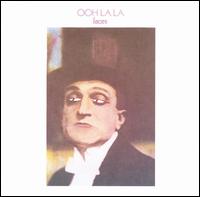
Ooh La La

Ooh La La is the final studio album by the rock and roll band The Faces, released in April 1973.

With his career in the stratosphere due to successes from his solo albums, Rod Stewart became increasingly distanced from his band mates, who were by the time of the album's recording little more than his backing group in concerts. The album's recording would be plagued by Stewart's absence. Nonetheless, producer Glyn Johns held the group together, helping to placate tensions as he had with the Beatles during their Get Back sessions. Johns' contribution is acknowledged in the album's credits with the comment "Produced by Glyn Johns (see you in a year)," suggesting that the The Faces intended to work again with Johns on their next studio album - one that ultimately would never be made.

Shortly after the album's release, Stewart reported to New Musical Express that he felt that Ooh La La was a "stinking rotten album", later making things worse by telling Rolling Stone that what he had actually said was that the group was capable of "doing a better album than we've done". The rest of the group was understandably hurt by the comments. Ronnie Lane, especially hurt and not looking forward to being even more increasingly relegated to the sidelines, quit in June and was replaced shortly thereafter by former Free bassist Tetsu Yamauchi. The group recorded three subsequent singles, but never again recorded an album, disbanding in late 1975.

The cover is a photo of "Gastone", a stage character of Ettore Petrolini, an Italian comedian of the 1920s. The original LP cover was designed in such a way that when the top edge was pressed down Gastone's eyes would discolor and move to the side, while his jaw dropped into a leering smile.

Monday, February 13, 2012

Dethklok

Dethklok is both a virtual band featured in the Adult Swim animated program Metalocalypse, as well as a real band created to perform the band's melodic death metal music in live shows. The band was created by Brendon Small and Tommy Blacha. Dethklok is sometimes cited as an example of "comedy rock" on par with bands such as GWAR and Spinal Tap. The music heard on Metalocalypse is performed by Brendon Small, with others as needed. The first official Dethklok album was released on September 25, 2007, entitled The Dethalbum. The album debuted at number 21 on Billboard Magazine's Top 200 list. The band released Dethalbum II on September 29, 2009, and toured with Mastodon, High on Fire and Converge. Small and drummer Gene Hoglan performed on both albums.

In the Metalocalypse series, Dethklok is depicted as an extremely popular and successful death metal band. The band's fan base includes billions of metal fanatics, who frequently endanger themselves to watch the band perform live. With their widespread commercial success and lucrative sponsorship contracts, Dethklok is ranked as the world's seventh largest economy by the end of the second season.

The members of Dethklok are often portrayed as incompetent at almost everything not related to their profession. The band struggles to perform everyday tasks, including shopping for groceries, preparing food, and maintaining proper social relationships. They are often assisted by their manager and lawyer, Charles Foster Ofdensen, who frequently attempts to prevent the band from making poor decisions.


Saturday, January 14, 2012

Goody Two Shoes

"Goody Two Shoes" is a popular song by Adam Ant. The song was released on the album Friend or Foe in 1982. The title phrase is a disparaging term for someone who is overly virtuous or conformist, and ultimately comes from the children's story The History of Little Goody Two-Shoes, published in 1765.

Following the dissolution of Adam and the Ants in early 1982, Adam Ant pursued a solo career. His debut as a solo artist, "Goody Two Shoes" was written by Adam Ant and Marco Pirroni and produced by Ant, Pirroni and Chris Hughes. The song details Ant's frustration with press intrusion, which was reinforced by the video and his clean cut image.

The song was an instant hit, reaching #1 on the UK singles chart for two weeks in June 1982 and later repeating the feat in Australia. Despite the success, this was his third and final #1 single. The song was his first and biggest hit on the Billboard Hot 100 in the US, peaking at #12.

Interestingly, there are two versions of the cover. The first has 'Adam and the Ants' across the top of the sleeve and the later version just 'Adam Ant'. This is probably due to the confusion around the timing of Adam going solo, particularly as the song was performed by three fifths of the band (Adam, Marco and Merrick).

The music video presents a stylized vision of a day in the life of Adam Ant, from dressing in the morning to performing on stage, to being hounded by the media. At the end of the day, he takes home a woman journalist played by British actress Caroline Munro.

Tuesday, December 27, 2011

Thee Headcoats

Thee Headcoats were a band comprising Billy Childish, Bruce Brand, and Johnny Johnson. Childish was featured on guitar and vocals, Brand on drums and backing vocals, and Johnson on bass. The band was the most prolific of Childish's many musical projects, releasing fourteen full length albums. Formed in Kent, England in the late 1980s, the band was well known for its garage rock sound, explicitly sticking to this format on almost all of their albums. The band's signature sound as well as their prolific writing has been attributed to Childish's love of simple, direct recording. The band has been on multiple labels including Billy's own Hangman Records and Sub Pop.

Described in the New York Times as 'the king of garage rock', Billy and Thee Headcoats actually grew out of the British punk scene of the 1970s (both Billy and Bruce Brand playing in The Pop Rivets. The band recorded songs by The Clash under the pseudonym Thee Stash. The band also recorded a tribute album to Bo Diddley called Bo in Thee Garage. On their debut album, the band recorded new versions of songs written by Son House including "John the Revelator" and "Child's Death Letter," both of which were later covered by The White Stripes upon whom Thee Headcoats were a great influence. These three influences give a good idea of what the band's sound was like; punk mixed with pure rhythmic rock 'n' roll and blues.

The band played their final concert on May 12, 2000 at the Dirty Water Club. Billy Childish went on to play with The Buff Medways from 1999 to 2006. His latest group is The Musicians of The British Empire.


Monday, December 26, 2011

Zoogz Rift

Zoogz Rift (July 10, 1953-March 22, 2011) was a musician, painter and professional wrestling personality.

The Trouser Press describes Zoogz Rift as "an iconoclastic original" who is "as imaginative and stimulating as he is irritating and vitriolic." Rift was influenced by Frank Zappa and Captain Beefheart as well as Salvador Dalí and Ayn Rand. He began his recording career with the album Idiots on the Miniature Golf Course, released by Snout Records in 1979. His long-time collaborators include Richie Häss and John Trubee. Rift released several albums through SST Records during the 1980s. Keyboard Magazine, in a special "Experimental Music" issue, described Rift's album The Island of Living Puke as "moments of outstanding free-form rock, sandwiched between scrupulously obscene interruptions."

Zoogz Rift booked the UWF (Universal Wrestling Federation) in 1993. He left the promotion in March 1994, but returned in May 1995 to become Vice-President, alongside founder Herb Abrams. After Abrams died in 1996, the UWF promotion closed and Zoogz was left without a job. He hosted an online wrestling show, entitled Puke-A-Mania that provides a weekly assessment of WWE and TNA promotions, with Zoogz giving insight on wrestling issues. His rants on the show included the pushing of former WWF superstar Warlord, and his fascination with possibly training 60-year-old Vince McMahon to become a main-event wrestler. With Zoogz' former experience in wrestling, he claims he can train any man, via the techniques of the Golden Crab, as stated in Episode #3 of Puke-A-Mania.

Zoogz Rift died peacefully on March 22, 2011. His death was due to serious complications from diabetes which he had been battling for well over a decade.

Thursday, December 22, 2011

Stiv Bators

Steven John Bator, known as Stiv Bators (October 22, 1949 – June 3, 1990), was an American punk rock vocalist and guitarist from Youngstown, Ohio. He is best remembered for his bands, The Dead Boys and The Lords of the New Church.

In the course of his career Bators was involved with a variety of bands beyond those for which he was best known. These short-term bands included Hormones, with Dennis Comeau and Andre Siva, Frankenstein, The Wanderers and The Whores of Babylon (with Dee Dee Ramone and Johnny Thunders). He also recorded as a solo artist with Bomp! Records.

It was as the lead singer and driving force of the Dead Boys, however, that Bators helped pioneer the punk rock sound, look and attitude. The band quickly became a popular staple at CBGB's, the music club in New York City's East Village. The Dead Boys were featured in the independent punk rock film Punking Out (1978), Live at CBGB's (1977) and Crash 'n' Burn (1977).

Bators formed The Lords of the New Church later in 1981 with Brian James of The Damned and Dave Tregunna of Sham 69. The Lords became notorious for their live shows. A devotee of Iggy Pop, Bators had developed a fearless reputation in his Dead Boys days and continued such antics with The Lords, the most famous being the time he reportedly hanged himself during a show.

Later, the punk vocalist gained additional exposure through more mainstream film. In 1981, Bators co-starred in the satirical John Waters film, Polyester. Seven years later, Bators made a memorable cameo appearance as "Dick Slammer", lead singer of "The Blender Children", in the offbeat comedy, Tapeheads, starring John Cusack and Tim Robbins.

The Lords of the New Church broke up in 1989, when Bators injured his back and guitarist Brian James secretly began advertising for a replacement singer. When Bators found out he played the encore of the band's final show donning a T-shirt with James' newspaper ad printed across the front, he then proceeded to fire the remaining members on-stage.

In the summer of 1990, Bators was struck by a taxi in Paris. He was taken to hospital but reportedly left before seeing a doctor, after waiting several hours. Reports indicate that he died in his sleep as the result of a concussion. Dave Tregunna said that Bators, a fan of rock legend Jim Morrison, had earlier requested that his ashes be spread over Morrison's Paris grave and that his girlfriend complied.

However, in the director's commentary of the film "Polyester," in which Bators starred, John Waters, in relating Bators death, stated that Bator's girlfriend had snorted his ashes.

Monday, November 28, 2011

Fables of Faubus

"Fables of Faubus" is a song composed by jazz bassist and composer Charles Mingus. One of Mingus' most explicitly political works, the song was written as a direct protest against Arkansas governor Orval E. Faubus, who in 1957 sent out the National Guard to prevent the integration of Little Rock Central High School by nine African American teenagers.

The song was first recorded for Mingus' 1959 album, Mingus Ah Um. Columbia refused to allow the lyrics to the song to be included, and so the song was recorded as an instrumental on the album. It was not until October 20, 1960 that the song was recorded with lyrics, for the album Charles Mingus Presents Charles Mingus, which was released on the more independent Candid label. Due to contractual issues with Columbia, the song could not be released as "Fables of Faubus", and so the Candid version was titled "Original Faubus Fables". The personnel for the Candid recording were Charles Mingus (bass, vocals), Dannie Richmond (drums, vocals), Eric Dolphy (alto saxophone), and Ted Curson (trumpet). The vocals featured a call-and-response between Mingus and Richmond. Critic Don Heckman commented of the unedited "Original Faubus Fables" in a 1962 review that it was "a classic Negro put-down in which satire becomes a deadly rapier-thrust. Faubus emerges in a glare of ridicule as a mock villain whom no-one really takes seriously. This kind of commentary, brimful of feeling, bitingly direct and harshly satiric, appears far too rarely in jazz."

The song, either with or without lyrics, was one of the compositions which Mingus returned to most often, both on record and in concert.

Thursday, November 24, 2011

California Ăśber Alles


"California Ăśber Alles" was the first single by the Dead Kennedys. The record was released in June 1979 on Optional Music with "The Man with the Dogs" as the b-side. The title track was re-recorded for the band's first album, Fresh Fruit for Rotting Vegetables (1980), and the version that appeared on this single, as well as the single's b-side, are available on the rarities album Give Me Convenience or Give Me Death (1987).

The song focuses on Jerry Brown, the Governor of California 1975-1983 and 2011–present, and is sung from his perspective. An imaginary Brown outlines a hippie-fascist vision for America, in which his "suede denim secret police" kill un-cool people with "organic poison gas" chambers.

The lyrics were written by Jello Biafra and John Greenway, and Biafra composed the music in one of his rare attempts at composing on bass.

Saturday, November 12, 2011

Going Back to Cali

"Going Back to Cali" is single by LL Cool J from the Less Than Zero soundtrack and his third album Walking with a Panther. Produced by Rick Rubin and LL Cool J, the song was a success, peaking at #31 on the Billboard Hot 100 and #12 on the Hot R&B/Hip-Hop Songs, and was eventually certified gold by the RIAA on May 28, 1991. Rock band, Sevendust would cover the song on the Take a Bite Outta Rhyme: A Rock Tribute to Rap.

The music video and song were parodied in both "Going Back to Brooklyn" by Colin Quinn and "Going Back to Philly," a song promoting It's Always Sunny in Philadelphia with verses done by Jeru the Damaja.

Sunday, October 30, 2011

The Plugz

The Plugz were a Mexican-American punk rock band from Los Angeles, California that formed in 1977. They and The Zeros were among the first Chicano punk bands, although several Latino garage rock bands, such as Thee Midniters and Question Mark & the Mysterians, predated them. The Plugz melded the spirit of punk and Mexican music.

The band was formed in 1977 and was a contemporary of the bands featured in The Decline of Western Civilization. Their songs reflected the anger and angst of growing up Chicano, and this was reflected in their sardonic hi-speed version of Ritchie Valens' "La Bamba". The Plugz are generally acknowledged as being the first D.I.Y. punk band in L.A., having started their own PLUGZ RECORDS and later Fatima records.

The Plugz also feature prominently on the soundtrack to the movie Repo Man. They composed original instrumental music for the film, and performed "Hombre Secreto," a Spanish version of Johnny Rivers' "Secret Agent Man".

The Plugz accompanied Bob Dylan on his appearance on "Late Night With David Letterman" on 22 March 1984 for three songs: "Don't Start Me Talkin'" (by Sonny Boy Williamson), "Jokerman", and "Licence to Kill".

In 1984, The Plugz name was retired and the three members formed the Cruzados with Steven Hufsteter.

The Plugz reunited the three founding members for The Masque 30th Anniversary Party and Book Release show on November 11, 2007 at The Echoplex in the Echo Park district of Los Angeles, California.

Saturday, October 15, 2011

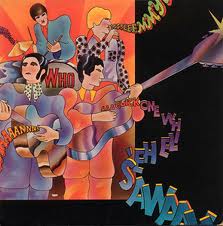
A Quick One, While He's Away

"A Quick One, While He's Away" is a 1966 medley written by Pete Townshend and recorded by The Who for their album A Quick One. The song also appears on the album BBC Sessions. In the performance on their Live at Leeds album Townshend calls the 9 minute "epic" track a "mini-opera" and introduces it as "Tommy's parent". This song tells the story of an unnamed girl who is left stranded by her lover "for nigh on a year." Her friends inform her that they "have a remedy"; the remedy comes in the form of Ivor the Engine Driver. When the lover returns, the girl confesses her infidelity, and she is ultimately forgiven.

The song has six distinct sections. The brief harmonized a cappella intro is titled "Her Man's Gone". The "Crying Town" section is sung by Roger Daltrey in an atypical low register. Daltrey also sings "We Have a Remedy" in his more usual voice. John Entwistle plays "Ivor the Engine Driver" in that section. Then comes "Soon Be Home", another harmonized section. Finally, "You Are Forgiven" is sung by Pete Townshend — his only lead vocal on the album.

This song is The Who's first publicized venture into the rock opera genre. A studio recording appears on their A Quick One album, and a live recording appears on Live at Leeds. A video performance was made for The Rolling Stones Rock and Roll Circus, and can be seen on that video and on the documentary film The Kids Are Alright. It also appears on both films' soundtrack albums. Another version recorded live at the Monterey Pop Festival can be found on the Monterey Pop Festival four-disk set and on another Who film, Thirty Years of Maximum R&B Live. A mixed studio and live version can be found on The Who's four disk set Thirty Years of Maximum R&B.

Saturday, October 8, 2011

Carolina Chocolate Drops

The Carolina Chocolate Drops are an old-time string band from Durham, North Carolina, United States. Formed in November 2005 following the members' attendance at the Black Banjo Gathering in Boone, North Carolina, the group is one of the few remaining African American string bands. There are three members: Rhiannon Giddens, Dom Flemons, and Justin Robinson, who were all in their twenties when the group formed. All of the musicians sing and trade instruments including banjo, fiddle, guitar, harmonica, snare drum, bones, jug, and kazoo. The group learned much of their repertoire, which is based on the traditional music of the Piedmont region of North and South Carolina, from the eminent African American old-time fiddler Joe Thompson, although they also perform old-time versions of some modern songs such as Blu Cantrell's R&B hit "Hit 'em Up Style (Oops!)."

The Carolina Chocolate Drops have released at least three CDs (in 2006, 2008, and 2010) and have opened for Taj Mahal. They have performed on Mountain Stage and at the Mount Airy Fiddlers Convention. Additionally they have performed on Fresh Air and BBC Radio in early 2010 and at the 2010 Bonnaroo music festival in Manchester, Tennessee.

On February 7, 2011, the band announced that beatboxer Adam Matta and multi-instrumentalist Hubby Jenkins would be joining the band, while Justin Robinson would be departing.

Their 2010 album, Genuine Negro Jig, won a Grammy in the best traditional folk album category, and was number 9 in FRoots magazine's top 10 albums of 2010.

Friday, October 7, 2011

Sheb Wooley

Shelby F. "Sheb" Wooley (April 10, 1921 – September 16, 2003) was a character actor and singer, best known for his 1958 novelty song "The Purple People Eater". He played Ben Miller, brother of Frank Miller in the film High Noon, and also had a co-starring role in the television program Rawhide.
Wooley was born in Erick, Oklahoma, and was raised on a farm. He learned to ride horses at an early age, and was a working cowboy and rodeo rider. He also played in a country-western band. Wooley tried to enlist during World War II, but was turned down for military service because of his rodeo injuries. Instead, he worked in the oil industry and as a welder. In 1946, he moved to Fort Worth, Texas, and became a country and western musician.
Wooley appeared in dozens of western films from the 1950s through 1970s, most notably High Noon. In 1954, he played outlaw Jim Younger in the syndicated western series Stories of the Century. Wooley appeared five times as Carl in the syndicated western series The Adventures of Kit Carson (1951–1955). He appeared in The Cisco Kid in the role of Bill Bronson. Wooley guest starred as Harry Runyon in the episode "The Unmasking" of the CBS western My Friend Flicka.
Wooley co-starred as Pete Nolan in the CBS western Rawhide (1959–1966) with Eric Fleming, Clint Eastwood, and Paul Brinegar. He also acted in the films The Outlaw Josey Wales and Giant.
In the 1940s Wooley took an interest in his wife's young cousin, Roger Miller (who also grew up in Erick, Oklahoma), teaching him to play guitar chords, and purchasing him a fiddle.
In the late 1950s, Wooley embarked on a recording career, with the song that made him famous, the "Purple People Eater". He followed this with a series of lesser novelty hits. Wooley wrote the theme song for the long-running television show Hee Haw.
Wooley also had a string of country hits, his "That's My Pa" reaching No. 1 of Billboard magazine's Hot C&W Sides chart in March 1962. He was a regular on Hee Haw and The Muppet Show as the drunken country songwriter Ben Colder. He released music and performed as Ben Colder as well as under his own name. Wooley had intended to record the song "Don't Go Near The Indians", but he was delayed by an acting job. Meanwhile, Rex Allen recorded the song and it was a hit. Wooley said he did not mind - he would do the sequel. His version was "Don't Go Near the Eskimos", about a boy in Alaska named Ben Colder (had never "been colder"). His song was so successful he continued using the name for forty years, one of his last recordings being "Shaky Breaky Car" (which parodied the song "Achy Breaky Heart").
Wooley is credited as the voice actor for the Wilhelm scream, having appeared on a memo as a voice extra for Distant Drums and later confirmed by his widow. This particular scream recording has been used by sound effects teams in over 149 films.
Wooley continued occasional television and film appearances through the 1990s, including an appearance as Cletus Summers, principal of Hickory High School in the 1986 film Hoosiers.
In 1996 he was diagnosed with leukemia. He died at the Skyline Medical Center in Nashville, Tennessee in 2003 and was buried in Hendersonville Memory Gardens in Hendersonville, Tennessee.

Wednesday, September 21, 2011

La Gazza Ladra

La gazza ladra (The Thieving Magpie) is a melodramma or opera semiseria in two acts by Gioachino Rossini. The libretto was by Giovanni Gherardini after La pie voleuse by JMT Badouin d'Aubigny and Louis-Charles Caigniez.

The opera is best known for its overture, which is notable for its use of snare drums.

Rossini was famous for his writing speed, and La gazza ladra was no exception. It was reported that the producer had to lock Rossini in a room the day before the first performance in order to write the overture. Rossini then threw each sheet out of the window to his copyists, who wrote out the full orchestral parts.

It was first performed on 31 May 1817 at La Scala, Milan. The opera was revised by Rossini for subsequent productions in Pesaro in 1818, and for the Teatro del Fondo (Naples) in 1819 and the Teatro di San Carlo (Naples) in 1820. He again worked on the music in Paris in 1866.

Riccardo Zandonai made his own version of the opera for a revival in Pesaro in 1941. Alberto Zedda edited Rossini's original work for publication by the Fondazione Rossini in 1979.

This overture, beginning and ending in E major, though passing through G major, makes a few appearances in Stanley Kubrick's A Clockwork Orange, and has also provided the background score for many television and radio commercials. It also appears during the famous baby-switching scene in Sergio Leone’s Once Upon a Time in America. The theme also appears during a musical interlude in Dario Argento's Le Cinque Giornate, arranged by Giorgio Gaslini.

The score is also frequently mentioned in Haruki Murakami's 1997 novel, The Wind-Up Bird Chronicle. It was also mentioned in Hergé's 1963 comic album The Castafiore Emerald: Opera singer Bianca Castafiore is slated to perform La gazza ladra, a fact that provides Tintin with a clue.

Sunday, September 18, 2011

Rodd Keith

Rodd Keith (born Rodney Keith Eskelin; January 30, 1937 – December 15, 1974) was an American multi-instrumentalist and songwriter. He is perhaps the best known figure in the obscure musical sub-genre known as song poem music.

He worked for several companies active in the song-poem business, a practice also known as song sharking, and generally dismissed as a scam.

Keith recorded hundreds of musical compositions based around lyrics sent in to song-poem companies by amateur songwriters, based upon small ads in the backs of mass market magazines promising success in the profitable field of songwriting. After a letter was sent by the company, the amateur songwriters would then be convinced to pay the company a fee to have a recording made and records pressed. Keith sang on many of these recordings as well as playing several different instruments, including saxophone, accordion, and all manner of keyboards.

During the late 1960s he had his most prolific period working for Clarence Freed's Preview Records label in Los Angeles. Keith masterminded recording sessions for hundreds of 45s and dozens of albums, working with female singers Teri Thornton, Charlotte O'Hara, and Nita Garfield (who used "nomes de disque" Teri Summers, Bonnie Graham, and Nita Craig respectively). Thornton, a promising jazz vocalist in the late 50s and early 60s, had fallen on hard times, while the latter two were ambitious singers and songwriters who'd had material recorded in the C&W and R&B markets.

Keith, who was born into a religious household and was even a musical evangelist for a time, fell in with a hard-living crowd in Los Angeles during the late 60s and early 70s, experimenting with different psychedelics. His music, at first jazzy, somewhat stilted, and ill-suited for the pop world, became more loose, funky, and with the times.

In December 1974, by which time he'd moved over to Maury S. Rosen's MSR Records, Rodd met his death on the Hollywood Freeway in Los Angeles. According to an article in the Los Angeles Times (which ran on December 16 of 1974) Rodd was seen "leaping or falling from an overcrossing onto the Hollywood Freeway," and he "plunged down the Santa Monica Blvd. overpass onto the northbound freeway about 5:15 a.m. and drivers could not avoid him." It has been suggested that this was a suicidal act, but Rodd's heavy drug use at this time has led others to claim it was an accident.

In the 1990s, record collectors who seek out old vinyl recordings rediscovered these obscure discs. Several compilations of these songs were released on compact disc, including several which featured the work of Keith exclusively. Keith's son, avant-garde saxophonist Ellery Eskelin, provided commentary on these releases. Although Ellery never actually met his father, he was told by many people that he was some kind of musical genius. Keith once remarked that he spelled "Rodd" with two d's because "God only used one."

"This American Life", an NPR show, had an interview with Ellery Eskelin, who spoke about his discovery of his father's works. This show originally aired August 15, 1997.